2011年2月10日 星期四

More on Dharamsala and Tibet


I met Yangchen Wanmo while roaming the streets of Dharamsala in pursuit of earrings. We became instant best chums when we discovered we were born in the same year. " Twin sisters !" Laughing, we fell into each other's arms in a spontaneous embrace . Yangchen spoke very little Chinese or English, so we had to look to her cousin Ahmaduo, who spoke passable Chinese, for translation. Yangchen was a widow. A dozen years ago, after the death of her husband, she and her four children smuggled out of Tibet and they had been living in Dharamsala since. Ahmaduo and her husband came much later, also via smuggling, and her daughter, 4 years old, was born in Dharamsala . Yangchen raised her family single-handedly by selling trinkets by the roadside . "Are you really better off here than in Tibet ?" I took Yangchen's work-worn hands in mine. Both cousins looked away, and after a brief pause, Ahmaduo said " It's difficult to say . We were told we'd have a better life here , we didn't know ........." . I got it . If you've little education you'll have a hard life no matter where you go. With little education you'd also be more prone to trust false propagenda . At dusk Yangchen's youngest son turned up to help her pack up shop . He just finished high school in the summer and had problem finding a job ; in fact none of his siblings had found gainful employment since they left school . "Wouldn't you consider further education ?"There was a sense of wistfulness about this handsome boy. " I might," he said in fluent English," or I might try to find job in another city ."


Dharamsala, for all its fame as "Little Lhasa", is an Indian city. Of its population of 20,000 , 5000 were Tibetans inhabiting the Upper Dharamsala. I'm long familiar with the Indian greeting " Namaste", which I first learnt in Nepal , but was now eager to show off my newly acquired Tibetan greeting: " Tashi Delek ", which I threw at every Tibetan I met. Tenzin was very amused by my effort . He had a make-shift table at the very end of the row, the jewellery displayed on it caught my eye because most of them were hand-made by him . Tenzin was a single guy of 32 , born and bred in Dharamsala, and his biggest wish in life was to migrate to Singapore .
" Oh, I know Singapore very well ! A lot of my friends say it's boring, but I like it ." I enthused. " But why did you pick Singapore ?" " My sister was married then settled in Singaore. I want to join her but my father refuses to let me go . He came here with the first wave of refugees and still dreams of returning to Tibet . Me, I just want to make a better living . " He held up a few pairs of earrings. "You've been to Singapore, how much do you think I can sell these for over there ?" " Well, at least 5-6 times what you ask for here, but don't forget cost of living's quite different there."


I met quite a few Chinese Tibetan lamas in the Dharamsala Tibbetan temples , distinguishable by bilingual Chinese/ Tibetan language abilities but no English . All the ones I talked to were on legal visas from the Chinese Government to study in Dharamsala . Andre our German friend made a big case about their learning the Chinese language as a part of " cultural genocide ". In Tibet, instruction in primary school is universally in Tibetan, Chinese language classes are brought in from secondary school onward . This has been blamed as the reason much fewer of the students enter tertiary education institutes, because their command of Chinese after just a few years of learning cannot meet the university entry requirement, so this is a case of you're damned whatever you do. Recently in Lhasa about equal time is given to Chinese, Tibetan and English classes in secondary schools . But hang on ! In Dharamsala the Tibetan children start learning a second language from primary school on , except , I beg your pardon, because it's English so it's not " cultural genocide " ! In fact the Tibetan exile leaders in India used English as the sole language and only became bilingual in 1994 . Indian schools in ethnic Tibetan areas do little to promote the Tibetan language, e.g. in Ladakh, instruction in school is in Urdu with a high dropout rate from Tibetans, yet India is never accused of "cultural genocide" against Tibetans .


Paradoxically, because of the affirmative action programs now available for Minorities in China, children of mixed Tibetan and Han parentage flock to register themselves as Tibetans so that they can claim the benifits . The same is happening with the Manchus who changed their names to Chinese after the fall of Qing Dynasty ; many have gone back to the Forbidden City where their old family records are kept to prove their genealogy so that they and their children can qualify for the programs. Under affirmative action the Tibetans do not have to pay taxes, they receive tax-free leases on land, low interest loans and duty free imports from Nepal, there's no restriction on the number of childbirths ( the 17th Gyalwang Karmapa has 6 sisters and 3 brothers ), and their children are given preferences for university admission and government promotion. The Tibetan lamas are the only religious personnels in China to receive free medicare and wages from the Government ; they also enjoy more autonomy than any other religious group in China.


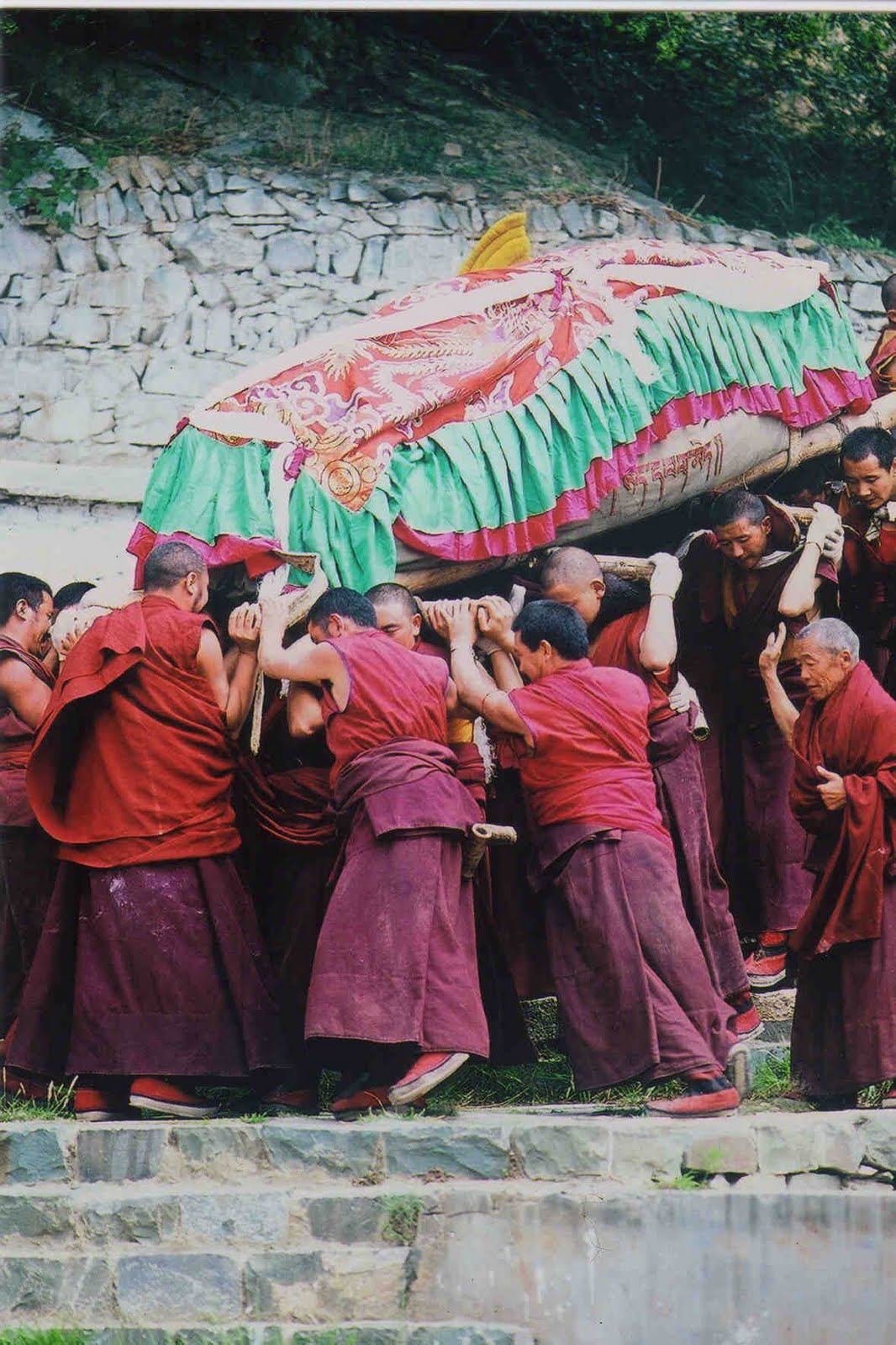


religious ceremony in Tibet

I tried to explain to Andre the biggest threat of " cultural genocide " is actually from the West. The day before I wandered into a wood-work shop to admire the handicraft, and instead of the calm Tibetan Buddhist chant I was bombarded with a blast of familiar rock music . " What's that music ?" I asked the several 20 year- olds who were working hard at the new pieces . One of them looked up." Aerosmith ! They're our favourite band " " Ah of course," I said, " the Bad Boys from Boston !" More and more young people are lured away from religious devotions as a way of life as they take on Western values for their own, and the social fabric's changing fast. An old lady in another jewellery shop I visited had other problems . Her daughter's away studying in the US for the past few years. " How does she like it there ?" I chatted with her while taking a rest." Maybe she'd meet a nice American boy and not come back " " No American boy !" She jumped up abruptly , index finger an inch from my nose. "Over my dead body, your hear ? Over my dead body ! " " OK !" I hastily took a step back " No American boy !" Tibetan mothers of girls in Dharamsala have much to worry about, for even if their daughters go with Tibetan boys there's no guarentee they would not be enticed to enter the annual Miss Tibet Pageant ( started in 2002) , which many elder Tibetans see as un-Tibetan. To them the body is the house of the conscience, modesty is a virtue and inner virtues cannot be tested and measured by a contest. When would they ever learn Modernization is not synonymous with Westernization ?!


Thanks to Dalai Lama Dharamsala has become a tourist magnet, boasting 400,000 foreign and an equal number of domestic tourists every year . Everywhere one looks, on lamp posts and on walls of small Tibetan run cafes, are adverstisements offering Natural Healing, Foot Reflexology,crash courses on Buddhism, Miracles and Instant Spirituality, many of them hand-painted signs in Hebrew . For 15 years Dharamsala welcomed the Israelis with open arms, evidenced by Israelic businesses in Mcleod Ganj and an exchange program between Jewish and Tibetan children. The downside of being a trendy tourist destination surfaced in recent years when the new visiting Israelis are mainly young soldiers looking to blow off steam after the army service, and bring with them their lifestyle of sex, drugs and rock 'n' roll to the young Tibetans . Guest houses, beer bars, Internet cafes and yoga studios mushroomed, unfortunately also tatto and piercing parlors that sell under-the-counter drug paraphernalia . It's no longer an uncommon sight to see youths pushing drugs to foreigners and locals in broad daylight , and the nightclub culture of "trance and drug parties" is fueling more trouble . Tourists are destroying the Tibetan culture they seek out , Dharamsala is fast becoming another Indian spiritual center devoid of spirituality, the once unique culture degenerating into wholesale markets of tourist- orientated junks .
The tourist economy has also taken its toll on the city. Dharamsala is ill-equipped to deal with the multifold problems of rapid commercial growth : imperishable garbage, a direct product of Western consumer goods, litters the streets and clogs up streams ; diesel fumes from hordes of tourist vehicles poison the local populace and the sanitation system's at breaking point under the weight of expansion .


Daila Lama's residence

What do the local Indians think about all these ? A Parsi family runs the oldest general store in Dharamsala which opened in 1860 . It once boasted of selling "everything from a pin to an elephant", but is now practically being squeezed out of the market. Parvez Nowrojee, the 5th generation proprietor of the store had this to say " We Indians got up and say, you better not call McLeodGanj " little Lhasa" because we don't want it to become a Lhasa only. This land belongs to us ". Ironically it was Nauzer Nowrojee, the founder of the store who persuaded Nehru to let Dalai Lama settle in McLeodGanj in the 1960s . Nonetheless Indians and Tibetans generally get on well as most Tibetans have begun assimilating with their Indian identity, and inter-marriage between Tibetans and Indians are becoming more common .


The leaders of the diaspora community have carefully cultivated an idealized image of Tibetans as religiously devout, non-violent people , this imge has been pivotal to its success in raising millions of dollars from foreign governments , private doners and celebrities the past 50 years . This has worked well because of Western ignorance of the fact that the "elite religious tradition" is essentially cultivated by the aristocracy which constitutes only a small % of the Tibetan population . The Tibetan general public is mainly secular and falls prey to the same evils of modern urban living as the rest of us, this is evidenced by an appeal I came across posted by a Mr Sumtsul in the Office of Tibet last year about crimes committed by Tibetan teenagers in New York . The news never hit the wider community because they only rob Tibetan families, sometimes in broad daylight . Poor parenting, long hours at work, women in the work force and divorces are blamed for the high drop-out rates of Tibetan students and subsequent delinquency in inner city USA .


Though the Tibetans in Dharamsala are one of the world's wealthiest refugee communities, sadly this is not reflected in their health status. In 2009 a dental survey found only 20% of 15 year olds were caries-free in the permanent dentition; child vaccination program covered less than 50% of the population , Choice HIV Institution reported around 200 HIV infected Tibetans in that year and Tibetans in exile suffer one of the highest rates of tuberculosis in the world : while in the United States the rate of TB is 4 per 100,000 people, in India it is 130 per 100,000, but exiled Tibetans experience a TB rate of more than 800 per 100,000 . Though TB is not the biggest killer for the community - cancer is, in particular stomach cancer, it's nevertheless a public health hazard . Overcrowded housing and poor sanitation facilities are partly to blame . Tenpa C Samkhar, Health Secretary of government-in-exile, added, " With little employment available in the hills, 60-65 per cent of Tibetans travel to metros and bigger cities to sell sweaters for a living in early winter. They set up shop in the most congested parts of town, where air pollution and dust concentration are very high. To cut costs, they skip meals and work all hours, making them vulnerable," Maybe it's time more resources are spent on health care than propaganda .


money lama , an American lama only interested in extracting donations

A few years ago I went on a tour in Tibet . The Head Guide was born in Tibet but left to live in Dharamsala when he was a teenager ; he returned to work in China because of the money. He spoke Tibetan with the local Tibetan guide but would only speak English to us , which became a sort of status symbol to him as the local guide could only speak Chinese . " Do you think Tibet should become independent ?" I asked him . " Of course !" He said . I glanced at the local guide and was surprised to see disagreement in his face. It dawned on me that the local guide was already unhappy with the savvy superior manner of the foreign returnee towards him , and mass return of these people would likely make him second- class Tibetans among Tibetans, just like the East Germans after German re-unification . A recent study in Germany showed significant differences in perception between the two Germans even at 20 years after re-unification . Afterall the 2 Tibetans had 60 years of different life experiences . The SIL Ethnologue estimates as of 2009, about 230,00 Tibetans are dispersed worldwide outside China : 100,000 in India, 50,000 in Nepal, 2,000 in Bhutan and 80,000 in the US, Canada, United Kingdom, Switzerland, Norway, Taiwan and Australia . Most of these Tibatans have presumably assimilated with the culture and customs of their respective host country .


Tibetan Head guide from Dharamsala

Tibetan local guide and cousin , it's considered an honour to have a lama
in the family

Through the years I've visited many Tibetan monasteries in Tibet, Qinghai and Gansu, and have never personally witnessed any religious restrictions. I struck up a conversation with Da Hai ( Big Sea ) , an industrious young lama in the middle of his PhD in Buddhism . " What's your thesis on ?" I asked. " On Death " He said . " I'd be most interested to read it, can you send it to me when it's done ?" " Well, I can but it's in Tibetan " Buddhism has a long history in China with a large number of followers , and in recent years Han Chinese patrons ( mainly from China but also from Taiwan , Hong Kong and Singapore ) are an important and growing source of financial support for Tibetan Buddhist temples and sacred sites .


Dai Hai Lama


Tibetans-in-exile have always accused China of " population Transfer ". The truth is as of 2000, 92.8% of the total population in Tibet are ethnic Tibetans, while Han Chinese comprise 6.1% . In big cities the % of Han is higher, e.g. in Lhasa Han made up 17% of the population . This is in contrast to the native Alaskans who made up over half of the population of Alaska in the 1940s, now they are just 15% as a result of migration of people from the lower 48 States .There has never been government- organised resettlement program in Tibet , only liberated labour migration policy. The harsh climate and high altitude of Tibet are natural deterrents . In the 1950s and '60s Chinese officials and technicians were put to work in Tibet , but all returned home after retirement ; they have since been replaced by well-educated and qualified Tibetans according to the new policy in early 1980s . The multiple huge infra-structure projects inevitably attract workers from all over the country, but almost all leave after the contract ends . Unlike some Western countries, there is no systematic discrimination of employees according to ethnicity, the labour market operates according to market principles and the most skilled people get the job , moreover employment packages are not origin-sensitive ( unlike Hong Kong under the British when pay and benefits differed according to origin ): all local Tibetans employees enjoy exactly the same pay and benefits as their non-Tibetan colleaques, e.g. Tibetans whose ancestors lived on the plateau of Tibet for generations are equally eligible for the "high-altitude allowance " . In fact Tibetans are accorded preferential treatment in State jobs -Tibetans make up about 2/3 of the government employees in Tibet, though the important adminstration positions are held by Han Chinese . The population of Tibetans has doubled since the 1950s , as has life expectancy. So much for the alledged genocide in Tibet, maybe these people got them confused with the Sioux, the Apache and the Cherokee.........


Distributing T-shirts to Tibetan school children for the YMCA

It is true there are still much problems in Tibet, some of which are no different from those affecting Hans in impoverished areas , others unique to its climate and locality . Tibetans are mostly subsistence farmers and herders, the highland economy is much less diversified than other parts of rural China , and the distance and isolation makes it a poor choice for industrial development . Tibetans are left behind possibly also because of culturtal and language differences , something hopefully education can eliminate by and by. In most Tibetan cities and towns, Chinese and Tibetan inhabitants live in separate quarters . This was not unlike how it was in Hong Kong under British rule, while the British and the HK Chinese might work side by side they basically led seperate lives, almost as if they lived in parallel universe . In the same way I sensed certain distrust between the Tibetans and the Han Chinese . While in Tibet I visited a local hospital. The Han doctor I talked to was from Shnaghai ; because of a shortage of doctors in Tibet he was rotated to work there for 2 years as a condition for promotion when he returned to Shanghai . He made a face when I talked to him about healthcare work for the Tibetans . He was disdainful about the Tibetans because they often didnn't pay the fees due, and he was scornful about their hygiene habits . My driver, Mr Pearl, was a Tibetan in his 30s ( therefore born under the Red Flag) , but when I asked him whether he had any Chinese friends he said no. I was so upset I threw my arms around him and told him I'd be his first Han Chinese friend , and he beamed with pleasure . I wrote him after I got back to Hong Kong but he never replied. Pearl was illeterate in both written Chinese and English.


I might be a trifle grandiose in calling myself Han so readily, for not too long ago, Hakka , my father's ancestry, was not accepted as Han Chinese. Even today many northern Chinese still have no idea where to put us as an ethnicity. It's fair to say Han is a concept that resonates more with the West than the Chinese . Han is not a particular race. After Han Dynasty was established all the people under its rule were referred to as Han ren ( Han people ) regardless of their nationalities / ethnicities ; it was just a way to unite a large number of different peoples over a wide area with the idea of a common culture. But in Han Dynasty, Guang Dong was a fiefdom of its own right and ruled by its own lord , and only until Tang Dynasty that the people in Guang Dong, Hakka as well as Tanka , were assimilated enough with the rest of Middle Kingdom to identified themselves as Tang ren ( Tang people) . Therefore Southern Chinese are more Tang than Han, and as most immigrants to the West are Southern Chinese, so overseas Chinese restaurants are always called Tang Zan Koon and never Han Zan Koon .

People in the West used to think of Chinese as a mono-ethnicity, but when they found out about minorities in China they instantly draw on their own history of ethno-religious conflicts and see China as a colonial state of Han lording over all of its minorities , a fact utilised by the Dalai Lama to propagate his independence rhetoric as well as revisionist history to appeal to the West . But racism has to be understood in a different way in China, for unlike the West which had colonized pretty much the whole planet for a few hundred years, there is no similar history of slavery, colonialism and ethnic genocide in China . In the whole of Chinese history, even when expansions were precipitated by military conquests , almost all were inevitably followed by granting full Chinese citizenship to the conquered of whatever ethnicity . The idea is not to exterminate peoples but to bring them under one rule . China has managed its ethnic minorities in a more enlightened manner than most developed countries . During the years of the Big Starvation Muslims were given rations of beef instead of pork ; minority tribes that do not have a written language have their music and customs mediculously documented and preserved . Though the Republic of China adopted Pu-tong hua as the official language in the 1940s, many minority languages are also spoken and none is in danger of extinction . Unlike the US, minority languages ( including Mongolian, Tibetan ) are actually printed on the yan . What is peculiarly Chinese is the way Chinese people habitually identify themselves with the province or city they come from, e.g. Guang Dong ren, Shanghai ren , and almost never by ethnicity and race . Han, like Anglo-Saxon, are ancient terms that has little meaning in the modern world.

Sun Yat-Sen, after 3 centuries of " foreign" rule of the Qing Dynasty, preached unity and peace under the Zhong hua ming zu . Sun did not want to create a "Han" Republic, but a multicultural one, with power vested in all its people . Upon its founding, the Republic of China recognized five major ethnic groups : the Han, Hui, Mongols, Manchus, and Tibetans ; but it was only after the Chinese Communist party took over and following the USSR model, that the different minzus-including the Han- were given any kind of official status . Today the People's Republic of China recognizes 57 ethnic groups


The large ethnic minority groups in terms of population include the Zhang at 16 million, the Manchus at 10 million, the Hui at 9 million, the Miao at 8 million, the Uyghur at 7 million, the Yi at 7 million, the Tujia at 5.75 million, the Mongols at 5 million, the Tibetans at 5 million, the Buyei at 3 million, and the Koreans at 2 million . Even then categorization of people as Han or various minorities was not based on ethnicity or genetics ( recent DNA studies has shown much differences between Han Chinese from the South and the North), and can be fairly muddled. Han was often used to include anyone who didn't fit into any of the artificially defined minority groups , with the result the definition of Han identity has varied throughout history. Prior to the 20th century, some Chinese-speaking ethnic groups like the Hakka and the Tanka ( except there're so many different dialects in the provinces it's difficult to know which can be called the definitive Chinese language ) were not universally accepted as Han Chinese, while some non-Chinese speaking peoples like the Zhuang ( linguistic classification , Zhuang is a series of dialects related to Thai ), were considered Han . Zhuang is the second most numerous ethnic group in China , it outnumbers all the 4 minorities in the "Wuzu gonghe " list but in actuality were made up of many tribes that had almost no cohesion before they were lumped together and classified as a "Zhuang " ethnicity in the 1940s . Today Hui Chinese are considered a seperate ethnic group, but aside from their practice of Islam, little distinguishes them from the Han; two Hans from different regions might differ more in language, customs and culture than a neighboring Han and Hui. During the Qing Dynasty, Han Chinese who had entered the Eight Banners military system were considered Manchu, while minority tribes seeking to overthrow the Qing stressed Han identity in contrast to the Manchu rulers . Few people realises this but true to the Daolist holistic principle of inclusiveness, the 57th minority group is actually the white 4th generation descendents of missionaries who could be of Scottish , English, Spanish, Portuguese or some other European origin .


When a country becomes large enough, it always becomes multi-national/ethnical / racial/ cultural , e.g. the Roman / British / America Empire . The definition of " Chinese " for today's world is therefore not culture but citizenship . Under Zhong Quo, all the people within its boundary should be referred to as Zhong Guo Ren ( Chinese ), regardless of ethnicity. The modern sense of Chineseness is one that comprehensively incorporates the histories and experiences of all its peoples , Han and minorities , each of these component cultures are embraced and celebrated as inclusively " Chinese" , but without denying the ethnic identityof individual people. In West Sichuan, young Tibetans marry Hans , go to university in Chengdu and otherwise being completely integrated in modern China, but all the while sticking to their identity and proud of being Zangzu ( 藏族 Tibetan tribe ) . On the other hand, two of my friends are Manchu but I wear Cheongshan ( a legacy of Qing Dynasty which is now regarded as Chinese National dress ) a lot , while neither of them would be caught dead in one !

I strayed from our tour group one day in Dharamsala and was immediately accosted by Norbu, a pony-tailed youth who claimed to be a "student " and offered to show me around. Norbu regurgitated the usual hard luck story of persecution and escape from China, and I had to patiently educate him the ways of the real world. To claim Tibetans are singled out for persecution because of ethnicity is a complete fallacy. Unlike the West, suppression from the Chinese Communist Government is almost always class- and ideology-based, and almost never along ethnic/ racial/ gender lines . In 1989, at about the same time theTinanmon Student Demonstration was brutally put down , some Chinese Muslims also staged a protest against a book they said defamed them. The Chinese Authority responded not by crushing the demonstration but by arresting the author and banning the book, as the Muslims were demanding not democracy but suppression of another viewpoint . The arrest and imprisonment of Han democratic reform advocates , including Liu Xiaobo, are cases in point. But how are things in supposedly democratic countries who proclaim to be campaigners of human rights and freedom of speech ? The FBI harasses and raids anti-war organisations and their leaders inside the USA because their viewpoint differed from the reigning US Government ; the CIA kidnaps foreign citizens ( including German and British ) in a third country and the US Government puts them in American prison for years without trial ; the secret service of USA , Britain and Germany spies on their own journalists and citizens, albeit in the name of Anti-terrorism . No different from China . All countries have skeletons in their closets but there are just too many double standards being thrashed about . Anti-riot Police put down riot in Los Angelos and Paris the same way riot in Lhasa was put down, but without the criticism China was heaped with .


top of the world

The Chinese Empire has waxed and waned from dynasty to dynasty over the past 2000 years , borders and treaties are at times so imprecise one can make it to mean whichever one wants . Even the Dalai Lama has said that the Hans and Tibetans have historically been like "brothers", which explains why Tibetans never bothered to demarcate their territory with the Hans . By far the only indisputable fact is China has more of a claim on Tibet than America has on much of the United States . While it would be wrong to blame all tension from minority groups in China on foreign incitement, it is nevertheless true some part of it can be traced to outside manipulations . Zhuangs at 16 million and Mongolians at 5 million are politically quiet because there's no advantage to any particular country to arouse them ( as yet ) . The Uyghur Independence Group is supported by the global Islamist movement which incidentally was initually created in reaction to Western Imperialism ; though it's rumoured the Uyghurs also receive part of their fundings from the CIA . On the other hand, the militant Tibetan Youth Congress , a rising Terrorist Organisation of violent extremists , definitely has close ties with the US , so much so their members are issued US citizenship under a special dispensation of the US Immigration Department.

At this point in time China-bashing is still centered on the 3Ts - Taiwan, Trade, Tibet . Andre, who's friendly with the Dalai Lama, told me with certainty Tibet will gain independence in 10 years, because the Oracle said so . Not to appear disrespectful of the Oracle but it's hard for me to conceive 5 million Tibetans ( less than the population of Hong Kong ) taking over one quarter of the whole of China's territory , which is what the Tibetan Youth Congress demands . It is inevitable the importance of the Tibetan issue shrinks in direct proportion to the rise in importance of China in the International arena .

China's time bomb lies elsewhere : unemployed rural migrants have been behind some of the worst violence of protests .

2010年12月16日 星期四

職微不自卑 位高不凌人

What constitutes a happy working environment ?

When I was working in the hospital we were terribly over-worked, the hours were long and the stream of patients unending . Yet we were happy, even today when I meet up with ex-colleaques and talk about old times we all agree those were memorable years. The reason we could maintain such high spirits inspite of the horrendous heavy workload was because we had great team work, we helped and covered for each other, the "bosses" were never bossy and we could see they worked just as hard as the rest of us . More importantly they were fair in their dealings with the subordinates.We appreciated each other and felt appreciated by the management , nobody's unimportant to the team , nobody's opinion's slighted or ignored , even the lowly interns' !

Since starting work in CUHK I quickly joined CUSA , and through the grievance cases brought to us by our members , I was shocked to realize there is another management culture at work here. While by no means all colleaques in management grade in CU are preposterous bullies, the problem is preposterous bullies are definitely allowed to flourish in the CU management culture. The story of our clerical friend who was made to wash glasses is not finished yet ; the caes was brought to the Personnel Dept and as expected all we got back was a cursory note stating: " all CU staff must do whatever the supervisor tells them to ", nothing was said on the reasonableness of the request, nor did they answer our question on whether they mentioned in the job advertisement that clerks in CU are expected to do amah's work, nor what their concept of specific training requirement for specific job is. In effect the Personnel Dept hid behind a bureacratic smoke screen and stonewalled us . Our clerical friend was given a lower rating based on unreasonable assessment elements in PRD just as she was threatened with and the irony is she told me if in the beginning the supervisor had been more civil when asking her to do the glasses instead of pulling rank with threatening words, she might have agreed to help out as a return favour. Time and time again I hear the same complaint , heavy-handedness and rudeness appear to be entrenched in the CU culture, from the top down . Except of course only the top brass can get away with brutish behaviour with no impunity .

I've tried again and again for many years in the JCC to get the University to install a reverse appraisal mechanism whereby a subordinate might rate their superiors but the Administration has put up huge resistance to the proposal , the reason is blatantly clear . I'd be extremely interested in hearing the views of all our readers, you'd be most welcome to send in your opinion, including personal experiences of unreasonable job allocations , unfair or discourteous treatment , which we could publish in our subsequent newsletters . The newsletter is afterall a platform for information exchange in all things pertaining to the wellbeing of our members .

If the new VC is really serious in reinventing a culture in CU that is based on mutual respect and cherishing of intrinsic human value of all stakeholders in CU as he said he did , he knows where to start .

Published in the CUSA Newsletter vol 19, Dec 2010

2010年11月23日 星期二

Of God and Man

Follow by faith alone is to follow blindly - Benjamin Franklin


The last day we were in Dharamsala Andre pulled some strings and managed to set up for us an audience with His Holiness the 17th Gyalwang Karmapa .

Present day Tibetan Buddhism has 4 major schools : Nyingma, Kagyu, Sakya and Gelugpa . Karmapa is of the Kagyu Lineage and the third highest lama . The Gelug School is headed by the Daila Lama , the Number One Holiness we were scheduled to meet but he was out of town .

The meeting started off on a sore note . We were herded into the reception hall like cattles by a thin cranky man in a black suit, and ordered sternly to leave everything: bags, cameras and anything detachable, in the lockers lining one wall." What are they scared of ? We hardly look like professional assassins !"I muttered to Connie standing behind me, as we waited in single file for our turn to be processed .

No sooner were we in the waiting room that the cranky man bursted in, plunked several bamboo trays on the table and barked " Put all your offerings in these trays ! I'll collect them later to be presented to the Karmapa. ", then rushed out . " What offerings ? We weren't told to bring any offerings !" Rita and I exclaimed in one breath . We looked at our empty hands in dismay and wondered if the Karmapa would now have second thoughts about receiving us .

I looked round the sparsely furnished room and nodded a greeting at a young novice lama huddled in one corner." Come sit here " he called to me in Mandarin, poining at an empty chair next to him. " You must be the group Karmapa is seeing instead of me ," he said miscerably, " I waited here to see him for many days and it should have been my turn today and I was so happy, then they told me I've to make way for a group from Hong Kong !" " Oops , sorry about that ! " I felt awful , " What do you want to see him for ?" " My monastery's a long way from here, a novice lama there is sick and cannot travel, he's my friend and he asked me to seek Karmapa's blessing for his health for him . " " Karmapa can treat diseases ?" I was incredulous . " Karmapa can do anything ! I was so looking forward to seeing His face and hearing His Holy words ........." Our conversation was cut short by the summon for our group to go upstairs to the palour where Karmapa receives his guests and worshippers .

Smiling Lama

The lama I dubbed "Smiling Lama" ( the only one who smiled in the whole establishment ) led us in and seated us in chairs arranged in a semi-circle facing the Karmapa, who occupied a big chair at the far end of the room . At first glance the Karmapa appeared to be just an overweight sullen young man and I wondered what all the fuss was about . The initial awkward silence was broken by Andre and Linda moving forward to present him with a gift . I heaved a sigh of relief : so we did have an offering afterall ! All the exchanges were in English up to that point and the Karmapa looked decidedly uncomfortable, his answers were hesident and brief, his eyes averted. I almost decided I wasn't going to like him when I remembered he had lived in China as a child , so I took a chance and spoke to him in Mandarin," Ni hao ! Ni hui Pu Tong Hua ma ? (How are you ? Do you speak Chinese ?) " The changes in the Karmapa brought by the Chinese words were dramatic, a big grin transformed his features into animative radiance and he relaxed back in the chair . What I mistook to be aloofness was in fact language impediment ! The Karmapa was actually a very good looking guy, and surprisingly talkative !

the 17th Gyalwang Karmapa Ogyen Drodul Trinley Dorje

Taking advantage of Mandarin being her native tongue, a Taiwanese in our group immediately launched into a lengthy convoluted question on spiritual enlightenment, which I mentally brushed aside impatiently . I wanted to know Karmapa the man. " What do you like to do in your sparetime ? Do you go on the net like all the other 20- year- olds ?" I jumped in before someone else came up with another inane spiritual question. " I like to go on the Internet but can't always do very much because the link's bad " Was it really bad connection or was there censorship in Dharamsala too, I wondered but knew better than to ask . " What's your day like ? I mean what do you do all day ? " " As a Karmapa I've to receive a lot of training, so I spent many hours studying the scriptures with my instructors . I also take classes in English and German , but I find foreign languages difficult . Then of course I receive guests and worshippers, and give sermons. " " So your days are planned for you ? Do you have any say in what you do ?"" Hard to say for sure," he hesitated," it's mostly just routine ," then to my astonishment added " Mei ban fa ! ( nothing I can do )" He kept glancing at the middle-aged man crouching on a low stool at one side of his chair, who was obviously the minder sent to monitor his every word . Apparently the Karmapa is seldom left alone , he has a personal instructor assigned to him since his authentication . " Do you have any hobbies ? Is there anything you enjoy doing ?" Karmapa laughed and said " You must have read in the newspapers about the model aeroplanes ! They printed a picture of me flying a model aeroplane and suddenly I'm obssessed with the toy ! I do like to fly toy planes but not how they said it in the papers . I do Chinses painting when I've the time "" Do you miss your parents ?" I had to ask . " Yes I do, dreadfully ! I haven't seen them since I left China. Of course there's no way I can return to China to visit them . I was hoping to get them visas to visit me here, but I was told the application met some obstacles. Mei ban fa !" he sighed . Poor Apo Gaga ( his nickname meaning ' happy brother ', given to him by his siblings before he was discovered to be Ogyen Drodul Trinley Dorje, the 17th Gyalwang Karmapa ) was plucked from his home in the Lhatok region of Eastern Tibet when he was 7 years old, and put in a monastery near Lhasa for spiritual training . He didn't get to see his family much even when he was in China, and since he was smuggled out of China when he was 14, he had not seen them at all . " What's it like to be a Karmapa ?" ( Karmapa means " the embodiment of all the activities of the buddhas") ." I didn't choose to be the Karmapa , mei ban fa , I was picked to be the Karmapa so now I'm in the life I'm in , I cannot have any family life, I cannot have another life experience , mei ban fa , " There was such a note of sadness and vulnerability in his demeanor that it caught me at the throat, then he continued valiantly " But since I'm the Karmapa, I'd do my utmost best to carry out my duties to my people, learn and teach scriptures to the best of my abilities . This is my life and I'd make the most of it "The minder indicated the meeting was at an end and if we liked we could have a group photo with the Karmapa .

After the photos everyone filed out of the room while I lingered back. " Have you ever been to Hong Kong ?" I asked " No, but I'd love to visit . I've friends in Hong Kong and I keep up with the happenings. It seems an interesting place " " If you're ever in Hong Kong give me a call" I handed him my card. He took the card and exclaimed " Oh, it's a different University !" " Why yes, there're 8 universities in Hong Kong. All the others in the group are from the Hong Kong University, I'm the only one from the Chinese University of Hong Kong . You're really welcome to visit ." He scrutinised the card carefully in the big spartan room, surrounded by that peculiar silence, the kind that befalls a house after a great party that everyone knows can never be repeated, and suddenly I saw him not as the big strapping 24 year-old but the lonely little boy caught up in the intrigues of a very murky adult political world . He looked so forloin I wanted to give him a hug . The minder was hovering at the back impatiently, and as I didn't know the etiquette on hugging a Karmapa , I said to him instead, " Do come ! You'd be among friends. " I didn't want to get him into trouble.

At the bottom of the stairs I was collared by the young novice lama . " How was the meeting ?" " OK" I blinked, not sure what to say. " Oh Please tell me !" the poor chap pleaded dejectedly "The Karmapa has such a tight schedule I don't know when they can fit me in again. What did he say please ?" " We talked about Hong Kong , " " Really ? " the novice didn't bite , " Yes really ! He has friends in Hong Kong and he wants to visit, so we offered to give him directions " Inexplicably I wanted to protect the Karmapa . The Karmapa had been extraordinarily candid in all his answers, even to questions his 'normal' guests and worshippers would never have the audacity to ask . I was particularly touched by the heartfelt "mei ban fa !" which he repeated at least half a dozen times . Buddhism is the most egalitarian of all religions, yet the Tibetans have invented for themselves demigods, and I didn't want to let on to the young lama that the Living Buddha that he reveres is as vulnerable and needy as the rest of us." Did He say anything on the scriptures ? Come on, you have to give me something!" The young man wouldn't give up. I had absolutely no recollection what the Karmapa had said in reply to our only spiritual question but I couldn't disappoint him , so I quickly made something up from the top of my head " I think he might have said something about the Path to Enlightenment is through a Pure Heart " then scurried away as fast as I could . I'm going straight to Hell !

My concern for the Karmapa is well founded. Ogyen is in the dire position of being one of 2 contenders for the position of the reincarnated 17th Karmapa . Each candidate was put forward by the 2 opposing camps of the Karma Kagyu school , but the real bone of contention is control over the Rumtek Monastery and the many priceless art treasures, artifacts and relics within . Both Karmapas had undergone seperate processes of recognition carried out by different people at different times, in addition to seperate enthronement ceremonies and both independently have been performing ceremonial duties in the role of a Karmapa .

Trinley Thaye Dorje

Trinley Thaye Dorje , the other Karmapa, came from truly illustrious parentage . His father is Mipham rinpoche, the reincarnation of a very important lama of the Nyingma school, 3rd reincarnation of the 1st MR and the head of 13 Nyingma monasteries in Kham, besides a descendant from many generations of doctors and learnt medical scholars ; his mother Dechen Wangmo is of noble family, descended from King Gesar of Ling. Trinley received a modern Western education from English and Australian tutors and an intensive introduction to Western philosophy from prof Harrison Pemberton of Washington and Lee University in the USA. He's polished, conversant in foreign languages and travels extensively so it's no surprise he's well received in the West .

Our sweet Ogyen, on the other hand, came from a penniless " Nobody" nomad family, received a provincial education and in my opinion , too guileless for his own good ; since he was given refugee status by the Indian Government in 2001, had gone on pilgrimages mainly in India . The only thing going for him is the boast of his being the only living tulku ( reincarnated lama ) to be recognised by both the Dalai Lama and the government of China . His Holiness Shamar Rinpoche, the second-ranking Karma Kagyu lama and the nominator of Trinley, was quick to point out that throughout the history of Tibetan Buddhism, each of the 4 autonomous Tibetan Buddhist schools has always selected its own leader, and though politically the Dalai Lama is head of the Tibetan government-in-exile, his spiritual authority is limited to his own Gelugpa school, and he has no religious authority to approve leaders of the other 3 schools. Nonetheless the Dalai Lama Effect has already gone forth , most Tibetans accept Ogyen possibly because of the association.

The 14th Dalai Lama and Ogyen

In the 1960s the 16th Karmapa Rangjung Rigpe Dorje built the Rumtek Monastery in Sikkim ( India), and set up the Karmapa Charitable Trust . Upon his death in 1981, the Karmapa Charitable Trust, of which Shamar Rinpoche was a board member, assumed management of Rumtek ostensibly until whenever the 17th Karmapa was found, who'd then take over when he came of age . In 1992, before Shamar Rinpoche could announce Trinley as the new Karmapa incarnate, Tai Situ Rinpoche and Goshir Galtsab Rinpoche jumped the gun and thrusted forward Ogyen as the real McCoy, and seized possession of the Rumtek in 1993. The ousted Karmapa Charitable Trust took the Rinpoches to court and for the next 10 years the 2 claimants embroiled in a bitter legal battle that eventually reached the Indian Supreme Court . In 2006, Trinley was officially appointed by the Karmapa Charitable Trust as the legal and administrative heir of the 16th Karmapa and could therefore, according to the trust, live in Rumtek Monastery should the Supreme Court rule in their favour, at the same stroke effectively affirms his status as the true 17th Karmapa .

Rumtek Monastery

It might seem odd that a religion that preaches desire is the cause of all suffering and all phenomena are empty to carry on such vindictive wrangle over power and material possessions, until one takes a close look at the history of Tibetan Buddhism .

Buddhism was brought into Tibet from India in the 7th century, integrated with the strong shamanistic and animistic indigenous Himalayan religion to become the Tibetan Buddhism of today, which explains the plethora of gods and spirits ( many actually from earlier Tibetan religions), the complex ritual practices such as prostrations during pilgrimages , prayers repeated over and over with the use of personal or public prayer wheels and flags , and noisy, visually striking temple ceremonies .

Different sects in Tibetan Buddhism emerged over time, all struggled for dominance as they developed. The inner fightings between and within each sect was evident from the beginning. The Nyingmapa Order is the oldest, dating back to the 8th century. In the 11th century Tibetan Buddhism became stronger and more politicized. The power of the ruling monks increased and the religion splintered into fiercely rivaling sects : the Kagyupa order and the Sakyapa order ( both Red Hat orders ). In the 13th century, the Mongols under Genghis Khan raided Tibet but was converted to Tibetan Buddhism by the Sakyapa sect, so with the assistance of the Mongols the Red Hat held sway over Tibet for about 100 years. The Gelugpa order, or Virtuous Ones, emerged in the 15th century as a purer form of Buddhism at a time when the other sects were regarded as corrupt .They were the Yellow Hat .The Yellow and Red Hats were traditional rivals, some have compared the Yellow Hats to Catholics and the Red Hats to Calvinists because the Yellow Hats donned colorful robes, lived in grand palaces, conducted elaborate ceremonies and put a great emphasis on following religious doctrines and texts while Red Hats are austere and mystical and look to the inner self rather than doctrines and books for answers.

The institution of Dalai Lama ( Gelugpa yellow hat ) originated from the Mongols . At the time when Sonam Gyatso was the third leader of the Gelugpa school, Gelugpa was being squeezed out by the other sects. Sonam turned to Mongolia for help and succeeded in converting the Mongol ruler Altan Khan, who coined the title Dalai Lama ( Dalai is a Mongolian word meaning Ocean of Wisdom, lama a Sanskrit term meaning guru ) to be bestowed upon him , making him the 3rd Dalai Lama . The previous 2 titles were conferred posthumously upon his earlier incarnations. Backed by the Khan, the Yellow Hat became preeminent in Tibet from this time onwards .

The 4th Dalai Lama Yonten Gyatso was a Mongol prince but he was unpopular with the other Great Monasteries . It's rumoured he was assassinated at the age of 28 by the Kagyus over the legitimacy of his confirmation. The death of Yonten marked the start of persecution of the Gelugpa school by the Kagyus .

In order to crush the Kagyus who was backed by the king of Tsang, the 5th Dalai Lama Lobsang Gyatso formed a military alliance with the powerful Mongol leader Gushri Khan, in the process razed a large number of Nyingma monasteries to the ground, and consolidated the power of the Dalai Lama by sword and fire . Lobsang based the new Tibetan government on the concept of Chhosi Shungdel, the integration of religion and politics, with clergy and laymen sharing power over the country, and was the first Dalai Lama to exercise temporal power and ruled as both a spiritual and political leader. Intelligent and formidable, Potala palace was built by his order. Towards the end of his reign he relinquished affairs of the state to his regent, Desi Sangay Gyatso, who was commonly thought to be actually his son . Desi concealed Lobsang's death for 15 years as he attempted to monopolize power, and only produced the 6th Dalai Lama when he was questioned by the Chinese Emperor Kangxi .

The 6th Dalai Lama Tsangyang Gyatso was by far the most interesting God-king . He was an erotic poet and wrote love songs which are still popular in Tibet today. While he lived as a Dalai Lama by day he was a dandy by night. Dressed in blue silk brocade, he wore his hair long, drank wine and visited brothels , reputed to take a different woman every night. His eccentric style displeased the Mongol chieftan Lozang Khan, who sought to depose him. Desi tried to protect Tsangyang by exercising intrigue. First he tried to poison Lozang Khan . When that failed, he attempted to assassinate him during the Great Prayer Festival of 1705. Lozang Khan responded by mounting a full-scale attack against the Desi, who was defeated and later beheaded. With Desi gone, Lozang Khan removed Tsangyang from the Potala with the blessing of the Chinese Emperor Kangxi, but met with resistance from the Tibetans. In order to avoid a massacre, Tsangyang surrounded . He was sent to Beijing and by official Chinese accounts he died of illness on the way , but other accounts say he was executed or murdered . He was 23 years of age . Tsangyang is the only Dalai Lama who is not interred in the great mausoleum in Potala, and the only one who entered the world of legend . Just like Elvis, many believed Tsangyang didn't really die, sightings of him abounded : he was seen masquerading as a mountain yogi, a sheepherder, a begger in Lhasa , he was spotted in a crowd at the court of the 7th Dalai Lama , still others say he went on a pilgrimage to India and spent 40 years in missionary work among the Mongols .

The candidate put up by Lozang as the 7th Dalai Lama in 1717 was rejected by the Tibetans, who turned to Dzungar Mongols for help to oust Lozang. The Dzungars defeated and killed Lozang, but then proceeded to loot Lhasa and the tomb of the 5th Dalai Lama . In 1720 a Chinese expedition expelled the Dzungars . The Chinese were hailed as liberators and patrons of Kelzang Gyatso, who they installed as the 7th Dalai Lama . Kelzang Gyatso was also a poet and a scholar, he was uninterested in matters of the state and was essentially a figurehead political leader . Emperor Kangxi declared Tibet a protectorate and in 1727 installed two high commissioners or ambans, and a garrison of Chinese troops in Lhasa . The walls of Lhasa were torn down and Kham ( with Batang , Litang, Tatsienlu, etc ) annexed to the Chinese province of Szechwan. The Chinese protectorate, which was to last till the end of the Ch'ing dynasty (1912) was established.

The 8th Dalai Lama Jamphel Gyatso was also uninterested in politics so Tibet was ruled by regents. During his reign, Tibet fought wars with Nepal, lost many cities which were later retrieved, but its strategic location in relation to India, China and Russia made it a focus of interest to Britain which sent on a delegation. Tibet reacted promptly by severely restricted outside visitors. Jamphel Gyatso died in 1804aged 46.

The 9th Dalai Lama Lungtok Gyatso died at the age of 11 in 1815, purportedly of pneumonia, but given the tumultuous state of Tibetan politics at the time, some believe he was assainated by his own court in order that they could continue with the status quo.

The 10th, 11th and 12th Dalai Lama were selected by a lottery method devised by the Qianlong Emperor of China, whereby the names of competing candidates were written on folded slips of paper placed in a golden urn, whichever name picked became the Dalai Lama . The 10th Dalai Lama Tsultrim Gyatso too died at a young age before assuming temporal power. The 11th Dalai Lama Khendrup Gyatso ascended the throne at the age of 17, then mysteriously died eleven months later . The short reign of the 12th Dalai Lama Trinley Gyatso was a time of severe unrest ; the weakened Qing dynasty was unable to provide Tibet with military support while the British intensified pressure on the Tibetan borders from their colonial bastion in India. Poor Trinley Gyatso died at age 19, barely two years after his enthronement .

The 13th Dalai Lama Thubten Gyatso was selected by the traditional incarnation's entourage ( labrang), with the selection being approved after the fact by Beijing. Since coming to power at the age of 19 , Thubten Gyatso survived an assassination attempt by his former regent who put deadly mantras in his boots, and fled Tibet twice to escape outside aggression - the first time in 1904 when the British marched on Lhasa and massacred a thousand Tibetan soldiers, during which time he fled to Mongolia ; then in 1910 when the Qing government sent a military expedition to establish direct Chinese rule, this time he fled to India. Nevertheless , following the establishment of the Republic of China in 1911, Thubten Gyatso sent Tibetan representatives to the Chinese Central Government as congressman, albeit largely in name only. Thubten Gyatso attempted to end Tibet's centuries long isolation, strengthen the political power of the Dalai Lama and introduce reforms, but it was too little too late .

The 13th Dalai Lama Thubten Gyatso

In 1950 at the age of 15 the 14th Dalai Lama Tenzin Gyatso was enthroned , one month after the People's Republic of China tookeover Tibet . Tenzin Gyatso escaped to India after a series of failed uprisings in 1959 , so effectively he abdicated and never ruled the country .

The centuries long feud between sects is still very much alive today . Feb 1997, 3 close associates of the 14th Dalai Lama : Geshe Lobsang gyatso (the principal of the institute of Buddhist Dialectics) and his two students were stabbed to death inside their school in broad daylight in Dharamsala. Accusing fingers were pointed at the Shungdens, a subset of the Yellow Hat, though the Indian police could find no proof. This is just one contemporary incident of the on-going Dorje Shugden Controversy, which started with the 5th Dalai Lama .

Geshe Lobsang Gyatso

Although the 5th Dalai Lama was of the Gelugpa School, he came from Nyingma tradition and throughout his life maintained a strong allegiance to the Nyingma school , which did not sit well with the Gelugpa hierarchy, led by the powerful monk Tukla Dragpa Gyaltsen, who was intent on creating a buddhocratic state based explicitly on the teaching of Tsongkhapa, the founder of the Gelugpa school. Tukla Dragpa Gyaltsen was murdered—suffocated to death by having ceremonial silk scarves stuffed down his throat— in his palace in 1656 by a close aide of the Dalai Lama. He was subsequently believed by his followers to have reincarnated as Dorje Shugden (meaning hurler of thunderbolts ), a vengeful protector god of the purity of Tsongkhapa teaching, often depicted as a sword-wielding warrior who wears a necklace of human heads and rides a snow lion through boiling blood.

Dorje Shugden

Only when a Dalai Lama holds effective political office that the Dorje Shugden controversy becomes prominent , so as the 6th to the 12th Dalai Lama were all basically defunct, the controversy slipped into the shadows for 200 years after the death of the 5th Dalai Lama . The 13th Dalai Lama again was a keen practitioner of Nyingma teachings, and ordered Pabongka Rinpoche, the most influential Gelugpa lama whose authoruty rivaled that of himself , to stop the practice of Shugden. Pabongka Rinpoche disobeyed and passed the practice on to his disciples

The 14th Dalai Lama initially practiced Dorje Shugden and repeatedly sought guidance from the deity, in fact it was on the advice of the Shugden oracle that he fled to India in 1959. In the 1970's some inauspicious dream led the 14th Dalai Lama to believe Shugden's negative energy was working against him and an oracle confirmed Shugden was really an "evil spirit", so in 1976 he issued his first statement discouraging the practice, but it wasn't until 1996 when public disputes and slanderous media campaign erupted between the opposing camps that the rest of the world became aware of the issue .

An estimated 80% of Tibetans follow the Gelugpa tradition and hence spiritually connected through the great Gelugpa masters with the Dorje Shugden. Distress arose when the explicit wish of Dalai Lama to ban the Dorje Shugden practice within the Tibetan community was enforced by the exile government . Houses were searched for pictures of Dorje Shugden , Shugden statues destroyed and temples confiscated ; lay and ordained practitioners coerced into signing their name, agreeing to abandon all worship of this Deity. Those refusing to sign were openly declared to be enemies to the cause of Tibet and endangering the life of the Dalai Lama. The consequences were bleak for those who stood by their faith: employees of the exile government were fired and children of Dorje Shugden practitioners were expelled from school. Even the constitution of the exile government was adapted to this change of policy: "The presiding judge of the Judiciary Commission … must not be a worshipper of Gyalchen Shugden …" Many Tibetan Lamas felt powerless to take action and fell in line with the Dalai Lama because their lives or livelihoods would be jeopardized. Advertisements from Tibetan Newspapers such as She-Ja and Bokyi Dhubab stated that anyone who opposed His Holiness the Dalai Lama must be dealt with ruthlessly by all means, including violence , and the Tibetan exile government's Department of Security published information on 10 prominent opponents, the so called "10 most hated enemies of Tibet and H.H. the Dalai Lama", profiling their names, addresses , occupation , photographs and defamatory allegations . Such information was posted on walls and widely distributed in the Tibetan settlement. Fear swept through the community and many Shugden worshippers appealed to the Commissioner of Police in New Dehli for police protection . ( Does any of this sound familiar to anyone ?)

Kelsang Gyatso

Upon receiving direct requests from distraught practitioners in India to help with the various kinds of religious oppression, the senior Gelugpa monk Kelsang Gyatso, who had been resident and teaching in England since 1976, formed an organization called the Shugden Supporters Community (SSC). Death threats and other warnings were promptly issued against him, followed by the "Sera Expulsion Letter" signed by fifteen abbots wherein he was 'expelled' from his old monastery, Sera-Je . In 1991Kelsang Gyatso broke away from the Tibetan Tradition to establish a new Dorje Shugden order in England and called it the New Kadampa Tradition (NKT). This is a Western adaptation of Gelugpa Buddhist organisation and does not accept the authority of the Dalai Lama. It's the fastest growing Buddhist sect in Britain, where it now has thousands of members, a thriving publishing business in London and mansions that double as "Dharma Centers" all over the country; it has since expanded rapidly worldwide, currently listing more than 200 centres and around 900 branch classes/study groups in 40 countries .

The Third forum in Beijing in 1994 and the Panchen Lama fisco in 1995 resulted in a fierce anti-Dalai Lama campaign from the Chinese . The Dalai Lama claimed an oracle confirmed the Chinese spirits were used by Dorje Shugden to attack him, thereby the Shugdens worked for the Chinese. This allegation led to great dissession among the Tibetans , and was made despite the fact that the Shugdens are, of all Tibetan Buddhists, advocate the strongest for Tibetan independence; indeed many Shugdens see Dalai Lama as a traitor for being too compromising with China. However, many Tibetan Buddhists have since heeded this call to arms and interfered with the development of the NKT and other groups who practice Dorje Shugden by defacing their publicity, contacting locations where classes are being held and tried to get them canceled, and banned all books by Kelsang.

The fight escalated and in 1996 the world was shocked by how Gentle Buddhism managed to generate its own scandal during the Dalai Lama's visit to England to give public talks . Acting from of a sense of "spiritual solidarity" for Shugden practitioners in India, hundreds of NKT members joined the Western Shugden Society and held demonstrations and prayer vigils against the Dalai Lama's ban with placards proclaiming "Your Smiles Charm, Your Actions Harm", requesting him to restore basic human right of religious freedom to Shugden practitioners. Many posters appeared in Dharamsala at this time declaring death threats to the Dalai Lama , which was followed shortly by the grisely murders of the three Dalai Lama disciples. The Dalai Lama used the media to great effect . In 1997, in a book by Dalai Lama published in the French language, he openly called Geshe Kelsang a cult leader. Subsequently Newsweek , Washington Post, Sydney Morning Herald and Ming Pao Daily all carried interviews of Dalai Lama in which he branded the NKT a cult and Kelsang the "third Buddha in the British Isles", intent only on grasping for himself power and wealth. In 1998, followers of Dorje Shugden again demonstrated against the Dalai Lama in New York during his visit there. Tricycle, a Buddhist periodical , dubbed the Shugdens "Taliban of Tibetan Buddhism" in a publication in 2002 , implicating them in the murders and death threats against the Dalai Lama . The NKT has all along vehemently denied involvement in the murders, and has since distanced itself from the Shugdens in Indian , citing the feud as an internal Tibetan political problem. Nevertheless, the smear campaign worked and Tibetans were incited to further harassment of Shugden followers in Dharamsala .

Is Dorje Shugden tradition really demon worshipping ? The NKT has a totally different explanation of the deity : " In his left hand he holds a heart , which symbolises great compassion and spontaneous great bliss ...... His round yellow hat represents the view of Nagarjuna, and the wisdom sword in his right hand teaches us to sever ignorance...... Dorje Shugden rides a snow lion..... and has a jewel-splitting mongoose perched on his left arm, symbolising his power to bestow wealth on those who put their trust in him....... His wrathful expression indicated that he destroys ignorance, the real enemy of all living beings, by blessing them with great wisdom." Tibetan Buddhism has a very complicated system of protector and destroyer deities ; afterall , the Land of Snows with its awesome, sparsely inhabited landscape and a fierce climate, could be a harsh and frightening place to live in. The very survival of communities require a powerful sense of family, tribal and religious loyalty, which could translate into Protector Gods who one must placate .

The portrayal of Buddhism as a tolerant, rational, non-dogmatic, peace-loving and open-minded tradition is enthusiastically endorsed by the liberal Western intellectuals, but in reality in the Polytheistic Buddhocracy of Tibet, all Buddhist traditions make claims to be the Truth, and when claims contradicted each other, passionate, prolonged even violent disputes have ensued. Sri Sri Ravi Shankar, a Hindu guru had impressed me by saying " There're many paths to God, we don't try to convert anyone ". It is therefore all the more shocking that in this day and age of supposedly global religious harmony, there exists still totalizing demand of a single claim to truth by a single voice, enforced through the path of repressive fanaticism and religious intolerance.

The Dalai Lama is widely respected in the West and held to be a paragon of virtue, being the first Buddhist to travel to the West to promote the concepts of universal responsibility, secular ethics, and religious harmony . His authority and opinions have never been challenged by Tibetans (or most Westerners) in all his years of rule, until the demonstrations by fellow monks made headlines in the 90's. The press has always gone easy on him , it's generally accepted by most media that it's a taboo to say anything less than saintly about the Dalai Lama, Mother Theresa or Nelson Mandela. Rarely do journalists challenge the Dalai Lama, but as head of government shouldn't he be held accountable as a political figure too , instead of letting him off on a good giggle and a quaint parable in place of hard answers ?

Speaking of the British monarchy more than a hundred years ago, Walter Bagehot warned of "Letting daylight into magic" , thereby turning magic into mere spectacle, now it appears Daylight has finally caught up with the Dalai Lama . Thinking people compare the Greats of the Twentieth Century and come to the conclusion that abdication is the abandonment of one's followers, a leader in exile is no leader at all. When London was being bombed with V2 rockets and buzz bombs, did Churchhill flee to America? Did Aung San Suu Kyi and Mandela leave their countries to save their own skin ? Then of course they didn't have the Oracle to lay blame on ! However, of all the lies that surround the Dalai Lama , the greatest is that he is a champion of non-violence, for which he was awarded the nobel peace prize in 1989.

In 1998, newly declassified agency documents were published by both Los Angelos Times and the New York Times , confirming what the Chinese had been charging for years, that the Dalai Lama was involved in a decade long covert violent resistance movement in Tibetan, and contrary to the claims by Lamaist Propagandists ( including the Dalai Lama) that these actions are a noble, home-grown resistance to foreign domination, the documents stated catagorically that the movement was organised, financed, trained, armed, led, and finally dispersed by the CIA, as part of the CIA's worldwide effort to undermine Communist governments .

As early as April 1949 when it was obvious China was turning communist, the US Secretary of State Dean Acheson cabled his Ambassador in New Dehli that the USA Government would like to see " Tibetan military capacity to resist quietly strenghened " . In the summer of 1950, instructions were given to the Office of Policy Coordination, the bureacratic arm officially in charge of covert operations, to "initiate psychological warfare and paramilitary operations against the Chinese Communist Regime." The Dalai Lama's two brothers became CIA agents in 1951, the same year the Dalai Lama formally accepted the 17 Point Plan" peace treaty from China uniting Tibet with the PRC . Three years later the Dalai Lama was elected vice-chairman of the Chinese People's National Assembly, and entered China's ruling elite , thus from 1956-1958, the Dalai Lama repeatedly refused lending support to various Tibetan tribal alliances in their resistance movement against the Chinese.

Chairman Mao and the Dalai Lama 1955


In 1951 Gyalo Thondup ( the second eldest brother), then based in Darjeeling, established an intelligence gathering operation with the CIA, and headed the "contra" ( counterrevolutionary ) armies the CIA has created to wage covert wars . Six years later he upgraded it to an advanced CIA-trained guerrilla unit. Ten Tibetan Contra camps were set up in the tiny principality of Mustang on the Nepal-China border, this major recruiting effort yielded 14,000 Tibetans and tribal people in the field , all armed, equipped and fed by the CIA. The first Tibetan Contra War was fought in late 1961 and continued through the 1960s. In 1958 theDalai Lama succumbed to the persuasion of his brothers , and authorized Thubten Norbu ( the eldest brother) to negotiate with the CIA on his behalf ; in June the same year, a full scale insurgent warfare was staged . In March 1959, an CIA initiated armed uprising was quickly put down, in large part because of the efforts of former Tibetan serfs who joined the People's Liberation Army to hunt down their old masters . At this point the Dalai Lama was whisked into exile in India .

from left to right are,Dalai Lama's mother; his elder sister; elder brother Thubten J. Norbu; elder brother Gyalo Thondup, another brother, Dalai Lama himself; his younger sister, and his youngest brother

Since 1958 , the CIA moved from dropping its own agents into Tibet to training a brigade of 2,000 Tibetan exiles, using Camp Hale in the Colorado Rockies, which lasted for 7 years. The Dalai Lama lied in 1961 when he said the Tibetan insurgents had no weapons except those left behind by the Chinese, records now show from July 1959 till May 1960, about 362 tonnes of weapons, ammunitions and equipments - as well as 85 trained guerilla warfare specialists- were dropped into Tibet .

By early 1970s the US was tied down in Vietnam, and at the same time sought to open relationship with China. The ineffectual Tibetan Contra was no longer useful , so they were simply cut loose by the CIA . This use-and-discard tactic of the US maybe a rude shock to the Tibetans, but all too familiar to reactionaries among the Kurds of Iran, the Hmong hill tribesmen of Indochina, the Miaquito Indians of Eastern Nicaragua, and the Islamic fundamentalist forces who fought Afghanistan.

Gyalo Thondup and Chinese leader Deng Xiaoping 1979

In 1997 Chicago Tribune stated that from 1950s until the 1970s the Tibetan Government- in- exile received US$ 1.7 million a year from the CIA ; the Dalai Lama was himself on payroll of US$ 180,000 a year until 1974, paid to him personally by the CIA. There's no question that the Dalai Lama pocketed the money for himself , more likely it was used on guerilla operations against the Chinese . An CIA agent alleges the CIA has been a prime funder of the Dalai Lama's media profile as a symbol of meditative peace and buddhist mindfulness, but notwithstanding his public stance in support of non-violence, his private conviction is at least consistent. When many political and religious leaders were cautioning the invasion of Iraq, in Sept 2003 the Dalai Lama told the press in his first visit to New York City since the 2001 terrorist attack that it might be necessary to fight terrorists with violence .

Preach Peace, Practice War

While virtually all religions that have become the dominant faith of a nation have had to come to terms with the military dimension of the nation's life , the Dalai Lamas of Tibet in the dual roles of God and King, had uniquely been the dispenser of both redemption and murder . All the demigods through the generation had feet of clay, and behind the holy cloak they had been the initiators of wars, political intrigues and bloody feuds, that is, if they're not themselves murdered by their own cout first . No one can serve two completely different Masters, even today many followers ( both Tibetan and Western ) would sacrifice compassionate Buddhist doctrines to the political agenda of Tibetan independence, and concede violence is acceptable if that's what it takes to achieve the end. In this respect maybe Jesus had the better idea . When questioned by the scribes whether it was lawful for them to give tribute to Caesar, Jesus asked "Whose likeness and inscription is on the coin ? " the scribes answered , " Caeser's." Jesus said "Then render to Caeser the things that are Caeser's and to God the things that are God's"( Luke 20:25 ).

For someone who's addicted to learning, my biggest personal disappointment with the 14th Dalai Lama is inspite of his name which means " Ocean of Wisdom", he has never said anything that I haven't heard before in some form or other ; this guy has not advanced human knowledge by one iota ! What will happen when the Dalai Lama dies ? The Dalai Lama had repeatedly stated that he'll never be reborn inside the People's Republic of China, occasionally suggesting that he might choose to not being reborn at all . In 2008 there was speculation that Ogyen might become the successor of Dalai Lama as the spiritual leader of Tibetan Buddhism , not as Dalai Lama but in his capacity as Karmapa . Ogyen had said since in the past the Gyalwa Karmapas did not engage in political activities so he won't either, so it's possible God and Caeser could finally part company. Ogyen, like Prince Charles, is mindful of the environment , urging his followers to stop using soaps and chemicals, and follows climate change through the Internet. And like Prince Charles, our Mei Ban Fa Karmapa, though of Generation Y, is resigned to be trapped by the life he was born into. On the other hand, how much real choice do we the unchosen ones, can claim to have ? We're all trapped to some extent in our choices in life by our heritage, genetics, gender, family background, educational opportunities ............. not to mention the times we live in . For example, if I were born a beautiful Five- foot- eleven Swedish blond, I'm quite sure my life story would be completely different .

Steven Seagal

However, the Dalai Lama could still surprise and delight us all by being reincarnated in America , like the 17th century treasure revealer Chungdrag dorje of Palyul Monastery in Eastern Tibet, who was discovered in 1997 by His Holiness Penor Rinpoche to have reincarnated and walk among us in the persona of Steven Seagal, the American action movie star. The egoistical Kung Fu star has lived a life more colourful than the 6th Dalai Lama, with 7 children from 4 relationships and a sexual harrassment lawsuit to boot ; he's also the proprietor of an energy drink aptly named "Steven Seagal's Lightning Bolt", and an aftershave called "Scent of Action". The fact that he was born of an Irish American mother and Jewish father was considered acceptable interracial reincarnation. This piece of information has raised my hopes greatly, who knows , maybe I could return as a beautiful Five- foot- eleven Swedish blond afterall !