
Dmitry Medvedev, the Russian President, visited the Ukraine round about the same time I did. During the visit Medvedev pledged to aid Ukraine's economic recovery by creating mutually profitable joint ventures in aviation, energy, industrial and financial sectors , plus granting up to $40 billion in gas subsidies in exchange for extending the lease on the Black Sea Fleet base in Crimea by 25 years ; but that's not what interested me . What interested me was the half-page spread in the KyivPost of President Viktor Yanukovych's visit to the Glory Park with President Medvedev, how a wreath at the Tomb of the Unknown Soldier fell on his head as he bowed to show his respect .

This interlude alone , though a trival embarrassing, wouldn't have made it the " YouTube sensation" it did but for the Administration's ham-fisted attempt to suppress reporting of the incident by requesting cameramen and journalists to surrender the images . Some didn't and in one week the clip had been viewed more than 1.3 million times on the web . Cartoons and jokes popped up in the press for days afterwards , such as : " Did you hear Ukraine's state prosecutors will open a criminal case against the garland ?" Or : " Medvedev wants to strengthen ties to Ukraine by building a factory to produce garland holders", proof that Ukraine has the freest press of all post-Soviet states, but also reflected the unpopularity of both the pro-Soviet President Yanukovych and the Kremlin visit.
The Authorities were so worried about security that the Kyiv Oblast Administrative Court issued a court order banning public demonstrations in Kyiv for the duration of the visit , which was promptly ignored by a number of nationalist groups and activists , including the FEMEN, an Ukranian feminists' organisation which boasts an inimitable protest style .

FEMEN worried Russification of Ukraine would worsen gender inequality in Ukraine, so Boob Protests were staged against the "Russian Bear "
Founded in 2008 by a group of Kyiv University students led by 25-year-old Anna Hutsol, FEMEN is now over 300 strong . I read : The mission of the FEMEN Movement is to improve the role of women in Ukraine's male-dominated, post-Soviet society ; to create the most favourable conditions and opportunities for young women to develop leadership, intellectual, cultural and moral qualities ; to uphold a national image of feminity, maternity and beauty ; to influence acute social issues ( one might conclude after scrutinizing a list of FEMEN protest causes that everything's their issue : hot water cut offs in Kyiv hostels ; the shortage of public toilets ; to improve the image of the subway; to fight porn and sexual tourism in Ukraine ; to support the Ukranian sailors held hostage by Somalia pirates ; to abolish life sentances for women ; action against the pre-term parliamentary elections ; to support Sakineh Mohammadi-Ashtiani, an Iranian woman on death roll for adultery; protest against privilaged VIP cars by blue bucket design painted on bare breasts ............. ) in fact, you name it and the girls would already have been out on the streets doing what they believe will help achieve their goal : exposing breasts, the " unique form of FEMEN civil self-expression" through which they claim to have "set up brand new standards of civil movement in Ukraine" . FEMEN has high hopes to become the " biggest and the most influential feminist movement in Europe "

I guess nobody would argue Ukrainian women are well qualified for this particular style of demonstration, they're so beautiful ! But good-looking women could be a double-edged sword for a country, both an attraction and a problem - Ukraine is fast becoming a prime European destination for " sexpats" and some 15,000 prostitutes operate in Ukraine's $ 800 million sex industry, even though prostitution is illegal in Ukraine . Ukraine currently has the highest rate of venereal diseases in Europe, with HIV prevalence one in 66 adults . Trafficking of Ukrainian women in sexual slavery to Western Europe , the Balkans, and the near East started in the early 1990' s , 85% were lured by the promise of employment as waitresses , dancers, or maids in hotels . An independent Human Rights Ombudsman reported over 100,000 trafficking victums and though prison sentences of up to 8 years are imposed on the offenders, very few are punished . Ukraine also has the dubious fame of being the "bridebasket of Europe ", and Ukrainian women are among the most highly prized commodity in the international marriage and dating industry. Sales pitch from the numerous matchmaking agencies ranges from citation of physical comeliness : " The beauty of the Soviet women is the best kept secret of the Cold War " to emphasis on the women's loyalty and old-fashioned qualities : " They make a man feel like a man " and " They're more artistic, more submissive, cheaper, and have better legs ", others offer a guarantee : "A wife within the year or your money back" . The sad joke around the world is : After the collapse of the Iron Curtain the most successful export of the former Soviet Union is its women.

It's a fact Ukrainian women under 30 ( particularly in Kyiv ) take to wearing a lot of makeup, skimpily clad in peek-a-boo mini skirt or flashy tight pants, and stileto high heels in any weather. I was given to understand this could be an over-the top counter- reaction to the dull colors, boring uniforms and no makeup of the Soviet era, except it's hard to convince people you're not a prostitute when dressed like one. Young Ukrainian women experience extraordinary hassle applying for visas and frequently face embarrassing interviews in foreign embassies . Coquettitishness appears to be in-born, highschool girls I stopped for a picture could give as good a pose as seasoned models , but flirtatious behaviour is generally viewed positively as gender roles are well defined in Ukraine - men are strong and assertive ,women beautiful and sexy.
High school graduates wear a sash for 2 weeks as celebration


Even then the cliche that Ukrainian women are pretty but shallow does not hold water, take Yulia Volodymyrivna Tymoshenko for example, the first female Prime Minister of Ukraine . Tymoshenko stunned the world with both her beauty and intelligence ; she has a Ph.D. in Economics , was a practising economist and academic , and a successful businesswoman . Ranked three times by Forbes magazine to be among the most powerful women in the world , she was dubbed one of the most beautiful women ever to enter politics by Daily Mail and 20 Minutos in 2009 .

Last year the World Tourism Organisation ranked Ukraine the 8th most visited in the world by the number of tourists visiting . Yet when I told my friends in Hong Kong I was going to the Ukraine this was the typical scenario : "Where ?" "Ukraine." Blank looks ." You know , Chernobyl nuclear explosion ?" "Oh, you're going to Russia ." " No, I'm going to the Ukraine " " What ?"Obviously the Ukraine-tourism heatwave has not hit Hong Kong , so it's no surprise our guide from Hong Kong didn't know too much about the Ukraine either . " Who are the Ukrainians ?" I asked " They're Russians " he said and effectively alienated an entire nation in one stroke . The Ukrainians are very sensitive about being branded as Russian .
The Indo- Europeans , first mentioned by ancient Greek writers in the 3rd century B.C. , were the ancestors of the Slavs ( slava means "glory" in Russian , Slovans mean the "glorious ones" ), who by A.D. 500 had separated into 3 main groups with different linguistics : the West, South and East Slavs.
The West Slavs inhabit Eastern Europe, have closer ties to Western Europe and practice the Roman Catholic faith ( Poland, Czech Republic, Slovakia ).The South Slavs live around the Balkan Peninsula and are influenced by the Byzantines, so are Eastern Orthodox, Roman Catholic and Muslim ( Serbia, Croatia, Slovenia , Bosnia ,Yugoslavia and Bulgaria ) . The East Slavs, the largest, reside north of the Black Sea, and are influenced by 3 cultures : Byzantines , Western Europe and Asia ( Ukraine, Russia ) . Though the East Slavs have common roots from Kievan Rus, the center of the first Slavic state, by the 13th century the East Rus people had evolved into a separate ethnicity (Russians) from the West Rus people who are the modern day Ukranians and Belarusians, culminating in 3 different living East Slavic languages and identities .

Ukraine ( kraina, old Slavic word meaning "country ", u-kraina means my country ) suffered 7 centuries of trouble with neighbours . Kievan Rus was the largest and most powerful state in Europe during the 10th and 11th centuries , but was weakened by internecine quarrels and fell in turn under the rule of the Mongols , Poland , Austra, Ottaman, Austro-Hungarian Empires , Czarist Russia and lastly the Soviet Union . Yet despite distinct periods of Polonization and 200 years of Russification, the Ukrainians have proudly kept their native traditions, customs and cuisine .
The national flower of Ukraine is the sunflower. " Why the sunflower ?" I asked. " Because the Russians say so " came the answer . This deftly illustrates the complicated and turbulent relationship with Russia which has cut deep into the Ukrainian psyche . To crush the Ukrainian national consciousness the Czarist regime suppressed the use of Ukrainian language in print and in public. To counteract ,Ukrainian Nationalist and Socialist parties were formed in the late 19th century. After the Czarist regime fell came a short-lived period of independence (1917-20) , then Ukraine was absorbed into the Union of Soviet Socialist Republic . Soon after, in late 1920's, Joseph Stalin begun concerted effort to destroy the Ukrainian spirit by forcible mass deportations of kulaks ( one million people ) and physical annihilation of the nationalist intelligentsia ( over 200,000 people ). Non-Russian nationals were relegated to second class status .
70 years of Soviet rule saw 2 man-made famines, first in 1921-22 and then the particularly horrific famine -genocide of 1932-33 in which over 8 million died . Dubbed the Holodomor ( In Ukrainian the word holod means "hunger", and mor means "plague", the word literally means "to kill by hunger"), the famine affected the Ukrainian SSR as well as the Moldavian ASSR (a part of the Ukrainian S.S.R. at the time), and was attributed to the radical economic reform ( forced collectivization of farming and industrialization) implemented by the totalitarian regime. But in 2006, the Security Service of Ukraine declassified more than 5 thousand pages of Holodomor archives, documents reviewed destruction of the Ukrainian peasantry, portrayed as counter-revolutionaries, was premeditated on the part of Stalin ; moreover Ukraine was singled out for terror-starvation ( excess grain exports, seizure of edibles from the starving, state refusal to provide emergency relief, bans on outmigration, and forced deportation to food-deficit locales), conducted against a backdrop of persecution, mass execution, and incarceration clearly aimed at undermining Ukrainians as a national group . Furthermore the State Great Terror of 1937-38 to purge "nationalist deviationists" by mass killing wiped out 4/5 of Ukrainian cultural elites .
Momument of Holodomor

The city of Kyiv is the twin city of Beijing . The Dnieper River running through it is one of the symbols of Ukrainian Statehood . Memorial to the founders of Kyiv was unveiled in 1982, commemorating the 1,500 Anniversary of Kyiv's foundation. It was dedicated to the legendary founders, the brothers Kiy, Schchek, Khoriv and their sister Lybed .
Memorial to the founders of Kyiv


Maidan Nezalezhnosti ( Independence Square ) is where political protests and the Orange Revolution took place

Kyivo-Pecherskaya Monastery, the cave monastery ( UNESCO 1990 ). The Great Lavra Belltower is the notable feature of the Kyiv skyline. The Pechersk Lavra caverns consist of underground tunnels with living quarters , chapels and catacombs which stretch as far as Moscow and Novgorod .

St Sophia Cathedral ( UNESCO 1990 ) one of the city's best known landmarks, named after the 6th-century Hagia Sophia cathedral in Constantinople, and dedicated to the Holy Wisdom

St Andrew's Church ( my favourite church ), one of 4 architectual landmarks of Ukraine, is located on a steep hill . When the church was built in the 18th century, a spring opened under the alter, legend has it the site was once surrounded by the sea, which disappeared the moment the Apostle St Andrew erected a cross on it . The church has no bell tower, because it's believed at the first bell strike the waters would return and Kyiv would be flooded . The bad news is recently cracks were noted in the foundation, and preservationists're worried it might collapse even without the flood .

St Vladimir Cathedral ( 1862 ) in the centre of Kiev is one of the city's major landmarks and one of two major Ukrainian Orthodox Churches

Marinsky Palace ( 1752 ) was used as a residence for visiting members of the imperial family until 1917, it's now the official ceremonial residence of the President of Ukraine in Kyiv

The neo-classical building of the Verkhovna Rada , Parliament of Ukraine.

Gorodetsky House is decorated with freakish sculptures made of cement. Many legends surround the House, the most mundane is that it was built as an advertisement by the architect Gorodetsky together with the cement companies . A second story states the architect went crazy after the death of his daughter who committed suicide by drowning because of unrequited love, and decorated the house with fishes and mermaids which he thought came to his daughter after her tragic death. Another legend alleges Gorodetsky, besides being an architect, was a sorcerer and cast a spell on his house so that anybody besides his descendants could suffer great misfortune who dare to live in it . Gorodetsky went broke in 1913 , sure enough all businesses which subsequently used the building either went bankrupt, had their funds embezzled or were dissolved due to disputes . I love a good yarn !

Pyrohiv Village (1627 ) - an outdoor Museum of Folk Architecture and Life of Ukraine. Founded in 1969, the Museum contains over 300 pieces of folk architecture brought from all parts of Ukraine

The National Museum of the History of the Great Patriotic War ( 1941-1945) was ceremonially opened on May 9 (the Victory Day) 1981, by the then Soviet leader Leonid Brezhnev. This is one of the largest museums in Ukraine (over 300 thousand exhibits) centered around the famous 62-meter tall Motherland Statue, one of the best recognized landmarks of Kyiv. It was near the Victory Day and I noticed large bill boards were put up all over the country in memory of the Great War, and there seemed to be still a lot of emotions tied up with what happened 65 years ago. This is perhaps understandable when one remembers more than 1/6 of the pre-war population of Ukraine was killed during WWII. Ukraine had the higest casulties of all nations with more than 20 million dead ( 80% of the 26.6 million people lost by the USSR ), which is half of all WWII casulties and constituted the vast majority of Allied casulties .The Eastern Front had more combats than all the other European fronts combined .

Luckless Ukraine has always had demographic problem , its people were constantly being sent away or murdered . In the 19th century the Czarist Government transferred 1. 6 million Ukrainians to Kazakhstan and Manchuria , and after the defeat of National Revolution (1917-20 ) Ukraine lost substantial political emigrants to the West. Stalin got rid of one million rich farmers from Kyiv, and another one million from Lviv, not to mention tens of thousands all over Ukraine accused of political unreliability. In the 1980s shrinking population size , despite a young age at first birth and nearly universal childbearing, caused concern. Pension age in Ukraine for women is 55 and for men 60 , in 2008 for every 10 working people there're 9 pensioners, this was inspite of high death rate as a result of environmental pollution, poor diets, extensive smoking and alcoholism and deterioating medical care . 60% of the population are smokers, and while the legal age of smoking is 18, many start at 15 . Demographic crisis was made worse after Independence when low salaries and unemployment led to mass labour migration : 2-3 million Ukrainians left to work abroad, most illegally in construction, service, housekeeping and agriculture industries . To boost fertility, the Government has increased child support payment , and women if employed for a month or more are entitled to maternity leave up to 156 weeks ; plus paternal leave is garanteed.

The beautiful children of Ukraine


In Ukraine schooling is compulsory till 17 years of age, and literacy rate is 99.4%. 80% of the secondary school graduates go on to tertiary education.


Kyiv Day is a holiday in the last weekend of May. Actors and musicians perform out in the streets , and the celebration finishes off with a firework show at around 10 in the evening . I went to the Kyiv Day Cycling Parade to chat with the cyclists and met Anatoliy, a photographer of the event who kept taking pictures of me and of course I had to reciprocate !

Anatoliy, photographer


In Soviet times , economy of ukraine was the second largest in the Soviet Union, being an important industrial and agricultural component of the country's planned economy. Ukraine became a sovereigh and independent state in 1991, but transition to market economy was rocky : resistance to reform and liberalisation of prices and privatization led to backtracking, and in mid- 1990's Ukraine was plunged into severe economic crisis ; loose monetary policies pushed inflation to hyperinflationary level - for the year 1993, ukraine held the world record for inflation in one calender year . Ukraine experienced rapid economic growth from 2000 until the Worldwide Economic Crisis in 2008, when the GDP fell 20% in one year .
This joke was one of many that captured the mood of the time :
" I cannot sleep well because of this global financial crisis !"
" Ah , I sleep like a baby !"
" Really ?"
" Yes, I wake up every hour and cry !"
The past couple of years has seen signs of recovery, but complex laws and regulations, poor corporate governance, weak enforcement of contract law by
courts and corruption, continue to stymie direct large-scale foreign investment in Ukraine . I ran into quite a number of businessmen from China exploring trade opportunities . But the law stipulates only Ukranians or their naturalised spouses can own business in the Ukraine " Did you know to set up shop in Ukraine you'll first have to take a Ukranian wife ?" I asked the guys . " I'd rather take a Hong Kong wife " This undeserving cheeky remark was my reward for trying to be helpful ! EU is Ukraine's largest trading partner, Russia the second and China the third but the Chinese-Ukrainian trade volume is set to reach US $ 10 billion by 2012 . The famous black earth gives Ukraine its nickname "the breadbasket of Europe", top agricultural exports include barley, wheat and sunflower seeds . Ukraine once produced one-fourth of the total Soviet agricultural output, and if high-level diplomatic exchanges continue and Ukraine can unlock its agricultural potential, it just might become "the breadbasket of China" too.
Chinese Embassy in Kyiv, diplomatic ties were established in 1992. I had a brush with the police for taking this picture . Who knew taking pictures of Embassy was out of bounds ?

In addition to trading agreements, Ukraine and China agreed to cultural exchanges focusing on youth and student groups. Ten years ago over 10,000 Chinese college students studied in the Ukraine . The school fee was low then, US$1,000 per year and the Ukranian Government even threw in subsidies for board and lodging . The school fees had gone up 3-folds since and the subsidies were scrapped, today the student number has halved . Lesya ( Chinese name 小樂 ) , our Ukranian guide, studied Chinese in college and graduated with honors, then went on for further studies in Taiwan. Her special interest was " Chinese Idiom " and had ambition to write a book translating Chinese Idioms into Ukrainian . Regardless of what our HK guide might say about her Mandarin , it's still far better than mine and I for one am very impressed .

The Ukrainians have a long history of association with China . The Czarist Regime pursued a policy of mass colonization of the far east, so from the 1890s began to set up Slavic enclaves in northern Manchuria, China . By 1920, there were an estimated 200,000 Russian citizens in Manchuria, of which 100,000 were Ukranians . Most of the immigrants were engaged in the construction of the Chinese Eastern Railway ( CER), a joint venture between the Russian and the Chinese Government , as well as auxiliary activities such as lumbering, coal mining, agriculture, etc . Networks of schools, parks , hospitals, churches and other social infrastructures and amenities were established for the settlers . Harbin, the biggest city, was one of the few places in the world Ukrainian writers could write in the Ukrainian language, and the zest for independent Ukraine led to the setting up of the Manchurian District Council in 1917, which embraed 9 different Ukrainian communities in Manchuria until its demise in 1921. A consulate of the Ukrainian People's Republic(UPR) was established in Harbin ; a military unit of Ukrainians in Manchuria was even dispatched to Ukraine to assist the UPR's war efforts .
The second wave of Ukrainian immigration into Manchuria came after the Bolshevik Revolution in 1917, mingled with the Russian pro- Czarist exiles. The 1920s were heady years . The Monarchist Hetmanites briefly established a Monarchy with the help of German forces in 1918, which the UPR quickly overthrew, but while the UPR was just as quickly neutralised by the Soviet , supportors of UPR in China continued to flourished even after the Japanese occupation of Manchuria in 1931, culmulating in the creation of the Ukrainian National Colony as the legal representative of all Ukrainians in Manchuria in Jan, 1935. After the Soviet sale of the CER to Japan in 1935 the majority of Soviet citizens, including Ukranians carrying Soviet passports, returned to the USSR . With the outbreak of war between China and Japan, Japanese policy towards Ukrainians turned repressive , so the Ukranian community moved south to Tianjin and Shanghai where there was more freedom . Nationalist activities in Manchuria dwindled with the Soviet invasion in the summer of 1945 ; random arrests, deportations and repatriation successfully halved the Slavic population in Manchuria, while the rest gravitated south and emigrated overseas to Australia, Hawaii and Canada via Korea, Hong Kong, Macau, Indo-china and the Phillipines . The rise of Communist China put a stop to Ukrainian organisations all together, and by the 1960s the Ukairanian community in Harbin was reduced to a negligible number .
The Ukrainians have left profound and indelible imprints in Manchuria.They've laid the foundations for diversified agriculture, industrialisation and cultural pluralism in North China - Ukrainian cuisine is still in demand in Harbin , and the Ukrainian Orthodox Church of the Holy Protedtress is still in use, testimonies to a heritage that has not been lost . Today there are around 15,600 Slavic-Chinese in Northern Xinjiang, Inner Mongolia and Heilongjiang and are regarded as one of the 56 ethnic groups in China, they're functionally bilingual in Russian and Chinese .

Lesya has only been a guide for a year but she's tried all the Chinese restaurants in Kyiv, because all her assignments have been Chinese businessmen or government officials who would only eat Chinese food . When our HK guide decided HK people are no different, she took us to the Kowloon Restaurant , supposedly the best in Kyiv. It became our cafeteria and we ended up eating there 5 times ! If I were given the choice I'd eat Ukrairian food all the time, they're so so good ! Ukrainian cuisine stems from peasant dishes and I loved all of it , the borscht, the Yarenyky , the Kotlety Po-Kyivskomy ( chicken Kiev)...... even the salo, which made all the ladies cringe . Slao are cured slabs of fatback with or without skin , thinly sliced and served on rye bread with garlic, salt, or black pepper. It's a traditional snack accompanied with horilka ( vodka ) but can be so much more - salo when aged too long or exposed to light turns yellow as the fat oxidizes, it could then be used either as a water-repellent coating for leather boots , or as a bait for mouse traps or turned into home-made soap !


Founded in 1715 , Lvivska beer is very good

The colour of Ukrainian flag is blue and yellow : blue sky above yellow fields of wheat, and reflects Ukrainians' strong attachment to the land and its bounty, consequently bread is regarded as one of the holiest foods and essential for health . The bread and salt tradition, symbolizing prosperity as well as friendship, is well observed in Ukrainian rituals . Bread is offered to honoured guests , marriage proposals are sealed with exchange of gifts and loaves of bread, and during weddings it is customary to serve traditional bread called Korovai instead of wedding cake .

We were in Ukraine during the Trinity Sunday, Monday of the Holy Spirit and the Third Day of the Trinity; most Ukrainians are Orthodox and Eastern Rite Christians and celebrate the holy days,which are also known as the Green Holidays as many believers decorate their homes with green branches . Interestingly the Ukrainian coat of arms is a blue shield with a yellow trident, which is a symbol of ancient Slavic tribes, representing the division of the world into 3 spheres, the Earth, the Celestial and the Spiritual , but also the union of the 3 natural elements of air, water and earth . The concept of 3 happens to be similar to Holy Trinity .
Kyi Railway Station , the city's only long-distance passenger terminal . Ukrainians are one of the world's highest rail users and the railways total 22,473km. Railway is the main mode of intercity transportation connecting all major urban areas, port facilities and industrial centers as most road system has not been upgraded since the Soviet era . We were in a hurry to catch the train to Lviv, but jinxed by the Murphy's Law, had a car accident on the way !

Lviv is my favourite city in the Ukraine . The Old City Centre with its cobblestone streets is on the UNESCO World Heritage List ( 1998) . Lviv has
the most open and freedom-loving artistic climate in Ukraine; multiculturalism is ingrained partly because of its proximity to Europe, and partly because it was a major Jewish and Polish cultural center untill WWII, prior to that it was ruled by the Tatars .

" The tramline has been running along our bus for the whole time we'd been on the road, and it's been almost two hours !" I said wonderingly to Lesya .
" Yeah, Ukraine has the second longest tramline in Europe !" The first tram lines were opened on 5 May1880 and electric tram introduced in 1894. Lviv also has one of the oldest pharmacies in Europe, and in 1853 Lviv was the first European city to have kerosene lamp street lights, which was upgraded to gas in 1858 and to electricity in 1900 . In 1928 Prof Rudolf Weigl of the Lviv University, one of the oldest in Central Europe (1608), discovered the vaccine against Typhus .
While wandering round Lviv with Lesya I spotted a group of youngsters in military uniforms marching in the street. " Hey, who're they and what are they doing ?" I asked Lesya and tried to run after them ." They're crazies !" Lesya said and yanked me away quickly. Obviously not all Ukrainians are comfortable with the aggressive nationalism Lviv is noted for .This entrenched stereotype came about because in the 1980s Lviv was the centre of movement for Ukrainian independence from the USSR, it also played a key role in the Orange Revolution and many of the nation's political activists hailed from here .

Lviv Theatre of Opera and Ballet was built between 1897 and 1900 and opened on October 4, 1900

Tired from shopping for earrings, Lesya had the brilliant idea that we should have some chocolate cake in the best cake and coffee shop in Lviv. What do girls talk about over cake and coffee ? Men, of course !

The Ukrainians believe to see a pig in the street is good luck

Olesko Castle on the outskirt of Lviv where we had lunch . We were served the best pork I've ever tasted and authentic Carpathian liqueurs of various flavours, which turned out to be pretty potent . This castle is approximately 700 years old . An earthquake in 1838 left he castle virtually abandoned, then both World Wars added to its damage, finally a lightning bolt in 1956 almost finished it off .The castle was restored in 1985 and now houses a museum featuring furniture and art works dating from the 16th-17th Centuries. The statue outside the Castle was added by the Soviets during the reconstruction .


Tri Sini Spa Hotel in the Shkolnitsa Village , Borislav Town. One of the highlights of the tour for me was the stay at the Spa , not lest because of the invigorating mineral waters, but also the opportunity to go off on my own into the wooded hills and experience rural Ukraine in all its glorious green . Unfortunately I was one of the very few HK visitors who appreciated the experience ! The Spa was built for Russian tourists but as it was low season, I was the only customer in the Bar. I felt so sorry for the bartenders I decided to sample their specialty : Three Brothers' Cocktail, their only sale of the night !

Crimea is an autonomous parliamentary republic within Ukraine. After the Second World War it was developed as a prime tourist destination for tourists from all around the Soviet Union and neighbouring countries . The south coast of Crimea has a humid subtropical climate, a result of warm influences from the Black Sea ; summers can be hot ( the hottest recorded was 40°C ) and winters are mild (4 °C/39.2 °F Jan average) .

There're professional chess players on the water front who would play with enthusiasts for a fee

6 month old Baby being strapped in to be bounced 30 ft into the air

Quite a few of the Soviet astronauts were Ukrainians . I asked Lesya as a joke whether this is how they train their astronauts and she scoffed, " Some mothers are unfit parents, they're just too young and don't know better !" The marriage age in Ukraine for males is 18 and 16 for girls, early marriage is the norm but divorce rate is among the highest in Europe and there's much talk about the " Slavic Man Syndrome ". It is rumoured 80 percent of Ukrainian men are believers of "Salo-syla, sport-mogyla" ( "Lard is strength, while sports is death") : lack of exercise , drinking and smoking too much and eating unhealthily led to repulsive balding, beer-bellied sloths with yellow teeth and bad breath before they're middle-aged ; the guys only get away with it because in Ukraine female population exceeds male by 3 million ! Then there's the fact most Ukrainian men are homophobic and think caring too much about one's appearance is a gay attribute . Nevertheless I've to say I didn't see any truly disgusting Ukrainian men throughout my stay, and all the young guys were in fact quite sweet !

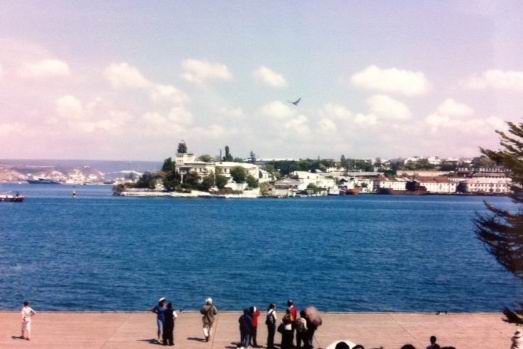
During World War II , Crimea saw some of the bloodiest battles. The Germans occupied most of Crimea with the exception of the port city of Sevastopol, which is an Ukranian naval base , and home of the Russian Black Sea Fleet . A new lease was signed recently with the Russians for 25 years from 2017 with an option to a further 5 additional years. It was an important center of marine biology research since the end of WWII, the training of dolphins as a secret weapon for special underwater operations was first conducted here.
Sevastopol Port
Chersonesos , Greek for peninsula, is an archeological site of ancient ruins near Sevastopol, it is one of the seven wonders of Ukraine .

The bell of Chersonesos , symbol of Chersonesos


Swallow's Nest Castle (1911 ) on the Aurora Cliff , is a symbol of Crimea, one of the best-known romantic castles near Yalta. It was originally built as a wooden cottage for a Russian general around 1895, and was named the" Love Acstle". In 1911Baron von Steingel , a Baltic German noble converted the cottage to the present day castle, but later sold it to be used as restaurant . The Castle was featured in the Soviet film "Desyat Negrityat ", the Soviet version of Agatha Christie's "And then There Were None", as well as a Jackie Chan movie .

The Palace of the Crimean Khans , in the town of Bakhchiasray ( derived from a Persian phrase meaning "garden palace" ), was from 1532 to 1783 the center of political, spiritual and cultural life of the state of the Crimean Tatars , and is the only remaining sample of the Crimean Tatar palace architecture in Ukraine . The `Fountain of Tears' , next to a bust of Alexander Pushkin , is in one of the Palace's inner courtyards. In 1820 , Pushkin told the story in a poem of one of the last Tatar Khans, Krim Girei, who fell in love with a Polish girl in his harem. When she died, the previously cruel and heartless Girei was grief-stricken. Acting out of character, he wept deeply, then ordered a marble fountain to be build , so that like him , the rock would weep too, for ever.

Livadia Palace (1861) was a summer retreat of the last Russian Tsar, Nicholas II. The Yalta Conference between the Big Three powers was held here in 1945 . Franklin Delano Roosevelt and the Amercan delegates were housed here during the conference .

Vorontsovsky Palace (1828 ) was the summer residence of Govenor-General Prince Vorontsov. During the Yalta Conference, Winston Churchill and the British delegates stayed here . Designed by English architects , it is an important example of Ukranian Gothic Revival Architecture .

All visitors to Ukraine must have come across Pysanka and Rushnik, both symbols of Ukaranian identity dating back millennia to Pagan times. Pysanka came from the verb "pysaty", meaning to write : eggs painted with designs to enhance their magical powers to protect, booster fertility and assure the coming of Spring. This practice came from an ancient legend which tells of a giant egg from which the universe emerged, an egg passed from one man to another signifies the giving of a new life to the other . Archeological excavations have uncovered buried eggs in fields and in homes intented to ward off evil . After the advent of Christianity, they acquired the Christian meaning of Easter eggs . Pysanka as a unique folk art was officially recognised in 1874 ,but was later suppressed by the Soviets who saw it as a symbol of Ukrainian nationalism .

Rushnik are traditional Ukaraine towels used to decorate and protect the house, for draping the windows as well as icons or holy pictures . A great deal of power is ascribed to Ritual Rushnik . Bridal couple must stand on rushnik when they take their marriage vows and their hands are frequently tied together with a rushnik ; parents of the groom traditionally welcome the new couple into their home with bread held on rushnik. Rushnik are also used to cover the lid of coffin during funeral, and as gifts for the pallbearers and gravediggers . The human body is a central symbol in Ukaranian culture, the power of rushnik could come from the power of the cloth in covering the body . The patterns and the colour scheme of the embroidery are highly symbolic . The most basic motif used for home is the" tree of life", which connects the underworld, this present world and the heavens above, besides representing continuity between the past, the present and the future generations of a family . Bouquets are modifications of "tree of life", an open wreath on a wedding rushnik indicates the couples' life and their future is ahead of them , while a closed wreath means the life being honoured is complete and is therefore used for funerals . Red and black are traditional colours, red stands for joy and black for sorrow, the two necessary extremes of life experiences.

Ukraine has the reputation of the "singing nation" from ancient times . The folk song of the 1960s " Where have all the flowers gone ?" was inspirated by a Ukrainian folk song mentioned in the novel 'And quiet flows the Don' by Mikhail Sholokhov : " Where are the flowers, the girls have plucked them. where are the girls, they've all taken husbands . Where are the men, they're all in the army ." Pete Seeger adapted it to a tune and Joe Hickerson added the other verses, the song subsequently became one of the biggest hits for ' Peter, Paul and Mary ' .


The Ukrainians are kind-hearted , friendly, hospitable, and hard-working, they're taught from early childhood to value singing, folk poetry and the land, so it's no surprise they're family orientated and patriotic. On the other hand they're freedom-loving souls, honest with their emotions, have little respect for law or authority, and are given to mysticism and irrationality as part of their mentality and temperament .
Brawl in the Parliament

Anti-government protest by religious group

Ukraine never ceases to amaze ! WELCOME TO UKRAINE!


