
The trip to Shanxi
was a blast, and made perfect by the 2 amiable passengers who sat next to me on
the flight back to HK. Ms Lee and Mr Hu were respectively the youngest (28ys)
and the oldest (78yrs ) of a troupe of 20 Chinese Communist Party members on a
joy trip to HK. All paid for by the Regional Branch of CCP in Shanxi.

We had a merry
chat. " We're very
excited, this is our first visit to HK" Ms Lee gushed . Mr Hu's a peasant from
rural Shanxi and this was his first plane ride. " I'm not at all scared" the old
man said hoarsely, but I noticed he didn't touch his lunch - the ride was a bit
bumpy. Ms Lee was assigned by the group leader to look after him , though she'd
flown before ( once or twice), this was the first time she's traveled outside
China.
Ms Lee couldn't
find a job to suit her talent since graduating from college 6 years ago, now
together with her boyfriend she's opened a tiny shoe stall near the market. He's
manning the store while she's away. They planned to get married in the coming
year ." I'm too old to be still single" Ms Lee
lamented "my younger sister's already had a baby " But I was more interested in
her other status. " How long have you been a CCP member ?"" Oh, quite a few
years, and Mr Hu here had been a member for over 60 years!"She said with
deep reverence. " Do a lot of young people want to join the CCP?" " Many ! But
not everyone would be accepted. We've to prove we're worthy" Ms Lee was worthy
because she had been an active CCP cadet since secondary school , turned up at
all the Party gatherings and was always politically correct. The group leader,
who's been to HK twice, walked down from the front part of the plane to check on
them both and briefed them again on immigration and customs procedure ; I was
surprised by the ordinary "family feel" of it
all.

The feeling of "Home" was dominant for much of the time
I was in Shanxi , perhaps unsurprising as Shanxi is one of the major cradles of
Chinese civilization. As early as one hundred million years ago, the ancestors
of Chinese, including the Yellow Emperor (founder of the Chinese nation) , lived
and propagated in this region. In Yuan Dynasty, natural
disasters and wars ravaged northen China, Hongtong in Shanxi in central China
was relatively spared, and became the principle place of refuge , These
displaced people put dowm roots in Hongtong, and the Ancient Grand Pagoda Tree (
洪洞大槐树), which was planted in Han Dynasty, was the symbol of
home for them .


Centuries later, in early Ming dynasty, the government decided to re-populate the rest of China . The residents were gathered at the Grand Pagoda Tree to receive order as to which province they'd be sent, all were reluctant to go, and each picked a leaf from the Grand Pagoda Tree as a keep-sake. In 50 years there were 18 forced emmigrations to 500 cities in ancient China, it could be said most of the Chinese in the world today can trace some of their roots back to Shanxi. A play is enacted a few times a day under the Grand Pagoda Tree to commemorate the event.

The great Chinese Scholar Tree Garden near by holds the
geneological records of 100,000 Chinese people, every year over 200,000
Chinese come here from all over the world to seek their roots. Since 1911, a
festival for ancestral worshiping is held here every year from April 1st to the
10th. Inside the compound is a screen wall that bears the inscription " Gen" (
root), written by Zhang Ding, the president of the All China Industrial Art
School.

Wishing tree

South of the Grand Pagoda Tree is Su-San's Prison. It's the only
well preserved Ming Dynasty county prison in existence today. Su-San's story of
intrigue and revenge is well known all over China, and has inspired several
Chinese operas including Yu Tang Chun ( 玉堂春 ) and
The Trial on Three Courts ( 三審狀元妻 ).
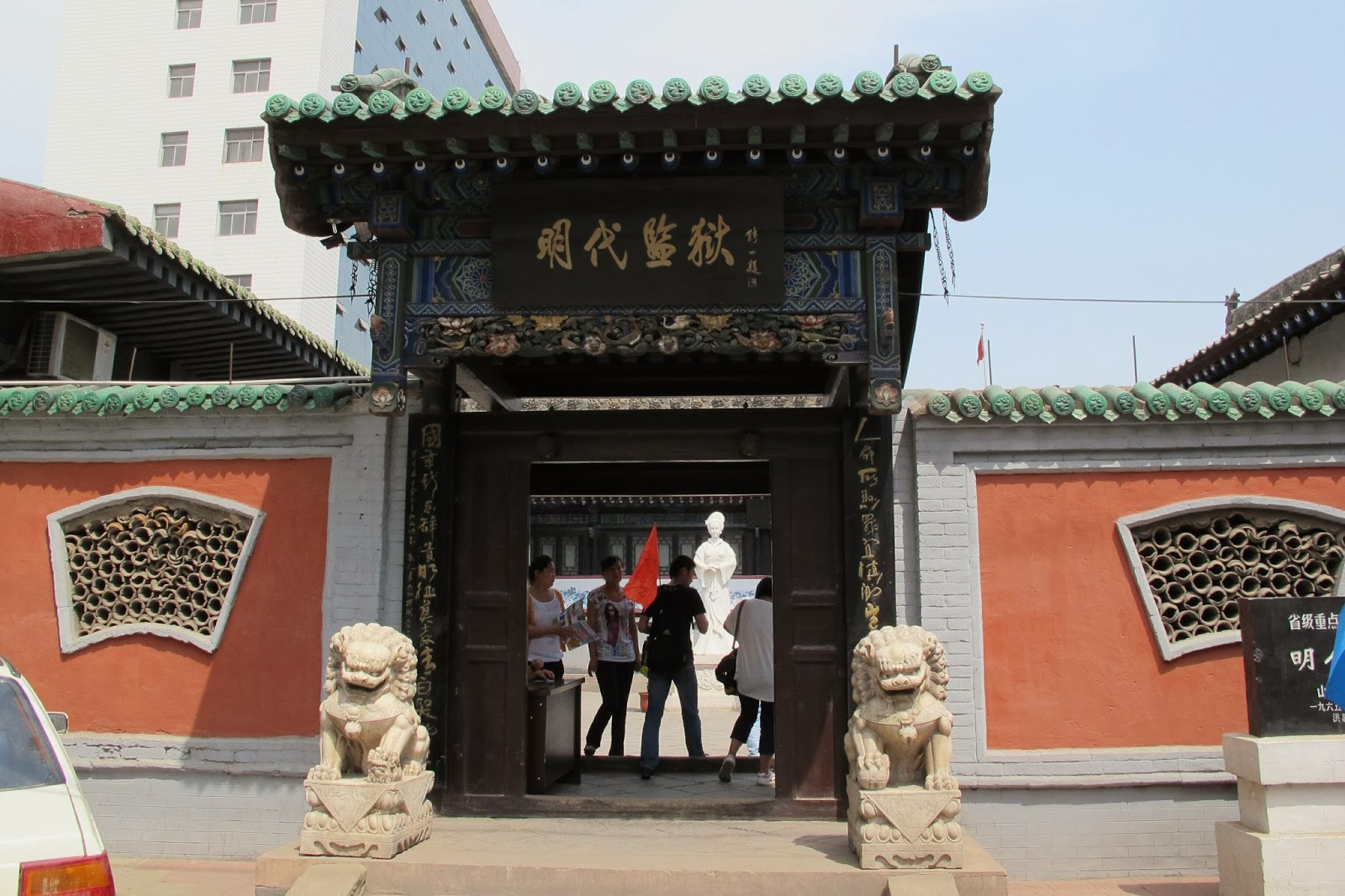
Su-San ( 苏三 ) Prison

Su-San , also known as Yu Tang Chun, was a
famous courtesan who was in love with Wang Jinlong. Wang fell on hard times but
Su-San gave him money and encouraged him to sit the civil service exam in the
capital. Su vowed not to serve another customer after Wang's departure, but the
owner of the brothel sold her to Shen Yanlin, a rich Shanxi merchant, as a
concubine. Su accidentally found Shuen's first wife was having an affair with a
young man. To stop Su from telling her husband, Shuen's wife tried to kill Su by
putting poison in her noodles, but Shen ate the noodles instead and died.
Shuen's wife bribed the magistrate to convict Su and she was thrown in prison,
which later was to carry her name. Su was escorted to Taiyuen to have her death
sentence endorsed by 3 senior officials, one of them an imperial ambassador. The
ambassador turned out to be none other than Wang, who had come first in the
civil service exam ! Wang pledged to save Su and dug around for evidence to
overturn the verdict. Eventually the maid of Shuen's wife confessed she put the
poison in the noodles by direct order of her mistress and Su was acquitted.
Su and Wang lived happily ever after. Curtains down .

The Tiger Head
Jail where the worst prisoners were kept, including Su-San

In China, there's a saying that goes : If you want
to see China's history for the past 10 years, look at Shenzhen; to see the last
100 years look at Shanghai ; to see the last 1000 years look at Beijing; Shaanxi
for the last 3000 years, and Shanxi for the last 5000 years. Shanxi is often
called the "Chinese Ancient Architecture Museum". Our trip started from
Taiyuan where we visited Qiao's Courtyard ; then to Jincheng, Susan Prison and
Hongtong Pagoda Tree ; followed by Tea Kettle Spout Waterfall, the ancient city
of Pingyao and Wang's Courtyard ; then to Mount Wutai ; from there we traveled
to the coal mining town of Datong and the near-by Yungang Grottoes, Nine Dragon
Screen , the wooden Pagoda of Yingxian and the Hanging Monastery ;
Yanmenguan and the underground tunnels built to fight the
Japanese invasion.

Taiyuan (太原) is the capital of
Shanxi Province and one of the great industrial cities of China. "
Taiyuan's pretty high up in the list of China's most polluted cities, isn't it?"
I asked Mr Wong our local tour guide. " We're doing better now, Inner Mongolia's
the worst, I think we might be the 5th or 6th this year " I wasn't sure if that
meant air quality in Taiyuan's improved or just that other cities had gotten
worse . Taiyuan's 10 hours train ride from Mongolia. In the Ming Dynasty,
Emperor Taisu sited nine military towns along the Great Wall to defend against
Mongolia, Taiyuan was one of them. Today Taiyuan's a modern city with high rises
mushrooming up everywhere." All these used to be farmlands" Mr Wong swung his
arm in a wide arc towards the seemingly endless rows of tall buildings speeding
past the bus window. "We don't have the land disputes with the peasants like
other cities because our mayor can afford to compensate them handsomely " He
boasted. " He's a popular
mayor"

Peddler in the street

Hotel restaurant

Unbeknownst to Mr Wong , the "popular" mayor of Taiyuan
, Zhang Bingsheng, had just been sacked for courting voters via SMS in the
January election , which was supposedly a violation of the election rules.
A government insider said Zhang had been in his post
for nearly a decade, and this election was his last chance to get a promotion
before retirement . Mr Wong was not alone in his ignorance at the time, for most
officials said they didn't get an internal briefing about Zhang's removal
either. Weep not for the fallen mayor though, because thanks to the forgiving
Party Politics , Zhang was reinstated
as the Deputy Director of the Shanxi Province Economic and Information
Technology Commission 2 years later.

Qiao's
Family Courtyard ( 乔家大院) became famous after Zhang YiMou's movie " Raise the Red Lantern" was shot on location there ; it was opened up to domestic
tourism in 2006. The Qiao's were Shanxi financiers , whose position in Qing
Dynasty was equivalent to that of JP Morgan and the Rockefeller families in
today's America . The Courtyard was an enclosed compound like a castle, with 6
big yards, 20 small yards and 313 rooms, decorated with exquisite upturned
eaves, bucket arches, stone and wood sculptures. The Yard was designed such that
when seen from above , looks like a Chinese character -Xi , meaning double
happiness

Chinese bride posing for a picture

souvenir shops


The
ubiquitous vinegar.

Shanxi is the hometown of
"over-mature vinegar Shanxi lao
chencu(山西老陈醋 ). The
written record of vinegar in China can be
traced back to the 8th century BC and has a
history of more than 3,000 years. As far back
as the Spring and Autumn Period, professional vinegar workshop had already
appeared. The old
saying "Firewood, rice, salt, oil, sauce,
vinegar and tea ( 柴, 米 , 鹽, 油 , 醬, 醋, 茶 ) are indispensable in our daily
life " shows that vinegar has played an
important role in the life of the Chinese through the
ages. China was the first country in the world to make
vinegar from grain . Shanxi mature
vinegar, e.g. is made from sorghum, barley, peas
and other raw materials, stewed at high temperature then
fermented for over a year ; it's claimed to be all natural and chemical-free. In
1924, it won the first prize at the Panama International Fair, and gained
international as well as domestic fame ever since. Some of the methods used in brewing Shanxi lao chencu have been considered intellectual properties and are under the protection of Chinese laws. .


We visited the Donghu Garden, a theme museum of Shanxi
Mature Vinegar Group Co LTD, where I bought 2 litres of the 8 year old mature
vinegar . Just like whisky, the price goes up from 1 to 15 year old mature
vinegar. Shanxi mature vinegar is dark purple and thick, gives off a full-bodied
odor, tastes mild and mellow, and has no sediment . Moreover, it doesn't go
moldy or ice up in winter, and the longer it is stored the more fragrant it
becomes. It's also been claimed to have medicinal value, particularly in
preventing hypertension, hepatitis and skin diseases. Apparently good for tummy
upsets too, a member of the tour who came down with gastroenteritis got better
instantly after 2 tea-spoonful of the 10 year old mature vinegar. Another
variety of the vinegar is said to have beautifying property. That I'd leave to
other ladies to verify - I've long given up hope anything'd work for me
!

Jinci Temple (晋祠寺) is located 25 miles southwest of Taiyuen City. It has a history of at least 1,500 years that can be traced back to the Western Zhou Dynasty. Originally an imperial garden, it was subsequently further expanded during the Sui, Tang, Song, Yuan, Ming, and Qing Dynasties, resulting in a mixture of architectural styles . It has over 100 halls ( including China's oldest classical ancestral hall, the Saint Mother Hall 圣母殿) , towers, pavilions, terraces, and bridges, 110 sculptures, 300 blocks and 37 cast arts, not to mention 300 stele inscribed with writings by emperors, officials and poets. All set in a beautiful landscape. In 1961 it was granted National AAAA Level Scenic Spot status and became part of the National Cultural Relic Protection Unit


But what took my breath away
in the Jinci Park was not the stately grandiose hall, but a lonely modest
building tucked away behind some trees . By the entrance was a small plaque with
the writing : 'Anti-Corruption Education Hall' . "This I've got to see !" I
spoke aloud before I realized I was all alone. Education Hall's actually
a misnomer, as it's just a big room to exhibit the biographies of all
the "clean officials" in China through the ages, up to the Qing Dynasty. In 5000 years of Chinese Imperial governance I counted just 10 acclaimed uncorrupted
government officials ! No wonder the hall's completely empty, of the 1.6 billion
Chinese I was apparently the only one fool enough to be duped by the promise of
"Anti-Corruption Education " in China. The disturbing revelation from all this
is : corruption's not a Communist thing, it's a Chinese thing.


The origin of the Yellow River (黄河) , China's second longest river, is at
the Tibetan Plateau. As the river passes the arid desert between Shanxi and
Shaanxi, it gets squeezed into a narrow gorge, the pent up pressure
results in tumultuous turbulence, water fumes and rumbling
noises that resembles pouring boiling hot water from a whistling tea
kettle when brewing tea. The site is thereby named the Hukou Tea Kettle Spout Waterfall ( 壶口瀑布) It's noted more for volume than a tall drop and is the only yellow waterfall in the world.

There's
a path a little way from the waterfall that led down steps through a norrow
passage-way to a lower viewpoint, which's on the same level of and almost face
up the falls.

In September
1938, during the Sino-Japanese War, Guang Weilan ( 光未然) , a
famous poet, was entertaining the Chinese troops at Hukou when he was deeply
moved by the sight of the Waterfall. He wrote the immortal poem - the ode of the
Yellow River (黃河頌 ), evoking the
image of the Yellow River as a symbol of Chinese defiance against the Japanese
invaders. This was put to music by Xian Xinghai ( 冼星海 ) in
1939, as part of the "Yellow River Cantata". Xian was regarded by Mao Zedong and
Zhou Enlai as " the people's musician", even so the piece was banned from
performance during the Cultural Revolution. Ironically because in 1970 Madame
Mao ordered rearrangement of the Cantata into a politically more loaded Yellow
River Piano Concerto, so at the official end of the Cultural Revolution in 1976,
the music was banned again ! Guess you just can't win
!

Dotted on the banks of the Waterfall were Drum Art Dance men with their colorful donkeys. The dancers were required to wear sheepskin jackets, red sashes, puttees or boots, and white towels on their heads.However most of this lot were too old to dance, but for a small fee one could take a donkey ride or have a picture with the animal.

I interrupted a Drum Art Dance man deep in a
chess game with his pals, and he agreed to do a dance for us . The people of
this area are mostly rugged hardy peasants, aptly reflected by the rhythmic and
sonorous drumbeats, and the quick vigorous body movements of the dance.

The Ancient
City of Pingyao ( 平遥古城) is one of the highlights of the tour. It's been an UNESCO World
Heritage site since 1997. The history of Pingyao goes back 2,7000 years, but the
city was founded in the 14th century. It is a well-preserved example of a
traditional Han Chinese city - the streets, residences and shopfronts still
largely retain their historical appearance. The city layout is from the Ming and
Qing dynasties, and conforms to a typical Ba Gua pattern. It's still inhabited
by 50,000 residents and is truly a living museum. The centrepiece of this
Heritage Site is however, the ancient city wall. Constructed in 1370 AD, the
walls are just over six kilometers in circumference and average about 12 meters
in height, with 72 watchtowers and four larger towers on each corner. The wall
has six barbican gates. The north and south sides have one gate each. The east
and west sides have two gates each.The layout is like that of a turtle (the
head, tail and four legs) earning Pingyao the moniker" Turtle
City".

City wall

Residences


Local residents


Pingyao was the birth place of the Jin (short for Shanxi
Province) businessmen, who were one of the 2 dominant business groups during the
Ming ( 1368-1644) and Qing (1644-1911) dynasties. China's first bank, the
Rishengchang Exchange House, was opened here in 1823. For the next hundred
years, Pingyao was
China's premier banking and financial center, and was to eighteenth century
China what Wall Street is to the US today. Rishengchang controlled almost 50% of
the silver trade in the whole Qing dynasty, using draft banking ( the use of
bills of exchange instead of real silver and gold ) which enabled the merchants
to do business nationwide conveniently. Rishengchang eventually went bankrupt in
1914, in part due to the downfall of the Qing dynasty, in part because of the
resistance of the owners to progress and the competition from modern banks. The
Rishengchang Exchange House was fully restored in 1995 and is now a major
showpiece .

Rishengchang Exchange House


Pingyao at night
.


Restaurant

soupy soft tofu dish
known as doufu nao (豆腐脑), a popular snack in north
China

We dined in the biggest restaurant in the old city and
was treated to a show which featured Jin Opera, which is one
of the Four Bangzi ( 京梆子) in Shanxi province.

35 kilometers
from the Ancient City of Pingyao is Wang's Courtyard, a monument to the glory of the
powerful Wang family. The Wang business enterprise commenced during the Ming
Dynasty and was a flourishing conglomerate by the middle of the Qing Dynasty,
encompassing farming and commerce as well as politics. Wang's Courtyard is 4 times bigger than Qiao's Courtyard but less "touched up". Reputed as the " first First Residence in Cathy", it's by far the largest residential compound throughout China, and is the epitome of Oriental domestic architecture. wang's Courtyard was opened to the public on August 18, 1997, and listed in the National Key Cultural protection Units in 2006. It is also a UNESCO World Cultural Heritage Site.


A fortified curtain wall
surrounds the whole mansion. Within
the
wall the biludings are divided into 3 distinct groups : the Ancestral Temple ( wangshi Zougci) and the 2courtyards.The 2 courtyards consisted of clusters of buildings facing each other, one on the east and the other west, therefore are called Gaojiaya ( East Courtyard) and Hongmenbao ( the West Courtyard is called Red Gate Castle because its gare is painted red) respectively. The 2 courtyards are totally enclosed castles complexes and are connected by a stone bridge across a moat. Movement within the castle is facilitated by a street that runs lengthwise and is intersected by three running crosswise, the pattern they form's in the shape of the Chinese character 'wang', the family name.


Wang's
Courtyard consists of a hundred plus compounds and a thousand rooms. The
arrangement of courtyard within a courtyard, door after door, gate inside gate,
and house above house creates a labyrinthine world. All the buildings, ranging from the eaves and roof ridges, the interlocking joints of timbers, wall screens, windows frames, shrines and decorative stone drums are adorned by a spectacular array of sculptures and carvings in stone, brick and wood.


Empress Dowager Cixi of Qing Dynasty was said to have slept in this bed when she was on the run from the Boxers towards the end of power

Mount Wutai
(五台山 "Five peak Mountain") is the first of the four Sacred Mountains of Chinese
Buddhism. The name comes from its distinct topography of five rounded peaks
topped with plain terraces. In 1992, Mount Wutai was approved as a national forest
park by the Ministry of Forestry and in 2007, was named a national AAAAA tourism
scenic spot by the National Tourism Administration, It has been
a UNESCO World Heritage Site since 2009.


Mt Wutai is a
holy land on account of being the abode (道場) of the Bodhisattva of Wisdom,
Manjusri (文殊), who taught in the mountain for a few hundred years. This was
attested by a sutra dated 418 AD. The Bodhisattva is believed to be still
frequently visit the mountain, taking the form of ordinary pilgrim or monk. Most
often though he'll appear as unusual five-coloured clouds. There was a coloured
photo of the clouds pasted on a temple wall to prove it. Words of wisdom were
chalked on blackboards which were also hung on the temple walls, not unlike the
" Big Character Posters (大字报)" during the Cultural Revolution
!


Buddhist
Master Zhencheng in the Ming Dynasty recorded that the first Buddhist
temple built in Mt Wutai was by the Han Emperor in 68AD, during
the first wave of Indian Buddhist evangelism. Mt Wutai was chosen because its
topography resembles the Vulture Peak in India, where Sakyamuni gave a discourse
on the Lotus sutra. Mt Wutai flourished and reached its peak
during the Tang ( 618-907) Dynasty with 360 temples and monasteries, and
attracted monks and pilgrims from India, Nepal, Sri Lanka, Burma, Korea and
Japan. The number of temples dwindled to 70 during the Song and Yuan
Dynasties, but picked up again during the Ming Dynasty. Under Mongol rule,
Tibetan Buddhism was first brought to Mt Wutai. Since then Tibetan Buddhism (Lamaism) is practiced
alongside Han Buddhism harmoniously. It was at this time that the Great White
Pagoda was built. During the Qing Dynasty ( 1644-1911), in order to
appease its Mongol and Tibetan vassals by way of the Tibetan Buddhist religion,
the state bestowed lavish support to monastic centres, and Mt Wutai benefited
hugely. By then there were about 25 Tibetan lamaseries and 97 Han Buddhist
temples on the mountain. Due to the social instability towards the end of the
Qing Dynasty and the early years of the Republic of China, Mt Wutai declined
dramatically. As to date, there're 68 temples on the mountain : 21 outside and
47 inside the circle of the 5 terraces. The assortment of different styled
temples in Mt Wutai serves as a catalogue of Buddhist architectural development
in the past two millennia, as it was in turn influenced by Nepal, Mongolia and
elsewhere. From Mt Wutai the influence would spread to the rest of
China.


The average altitude of all the peaks is over 1,000
meters, to reach any of the temples one has to climb up 108 flights of stairs.
Buddhists say man has 108 kinds of worries, and by climbing the stairs, one can
throw all those worries away. If only that were true !

The temples on the central Cuiyan Peak are mainly
Tibetan Buddhism temples.
On the east Wanghai Peak are Exoteric Buddhism ( 顕教)
and Tibetan ExotericBuddhism temples - the disciples believe suffering is
inescapable and must be accepted.
On the south Jinxiu Peak are Pure Land Buddhism temples
- the practitioners circle around the Buddha statue and recite his
name.
On the west Guayue Peak are Zen Buddhisn temples - in
Zen Buddhism meditation is the main focus.
On the north Yedou Peak are also Pure Land Buddhism
temples. The summit of the
North peak is called Beitai Ding, at an altitude of over 3,060 meters, it is the
highest point in the region and is known as the " Roof of Northern China". It is
surrounded by mystic clouds all year round.


Can't say I'm a big fan of temples,
fortunately there're a lot of people-watching.
The grounds of
the temples were festive, bustling with tourists and worshipers, there was even
an opera show.
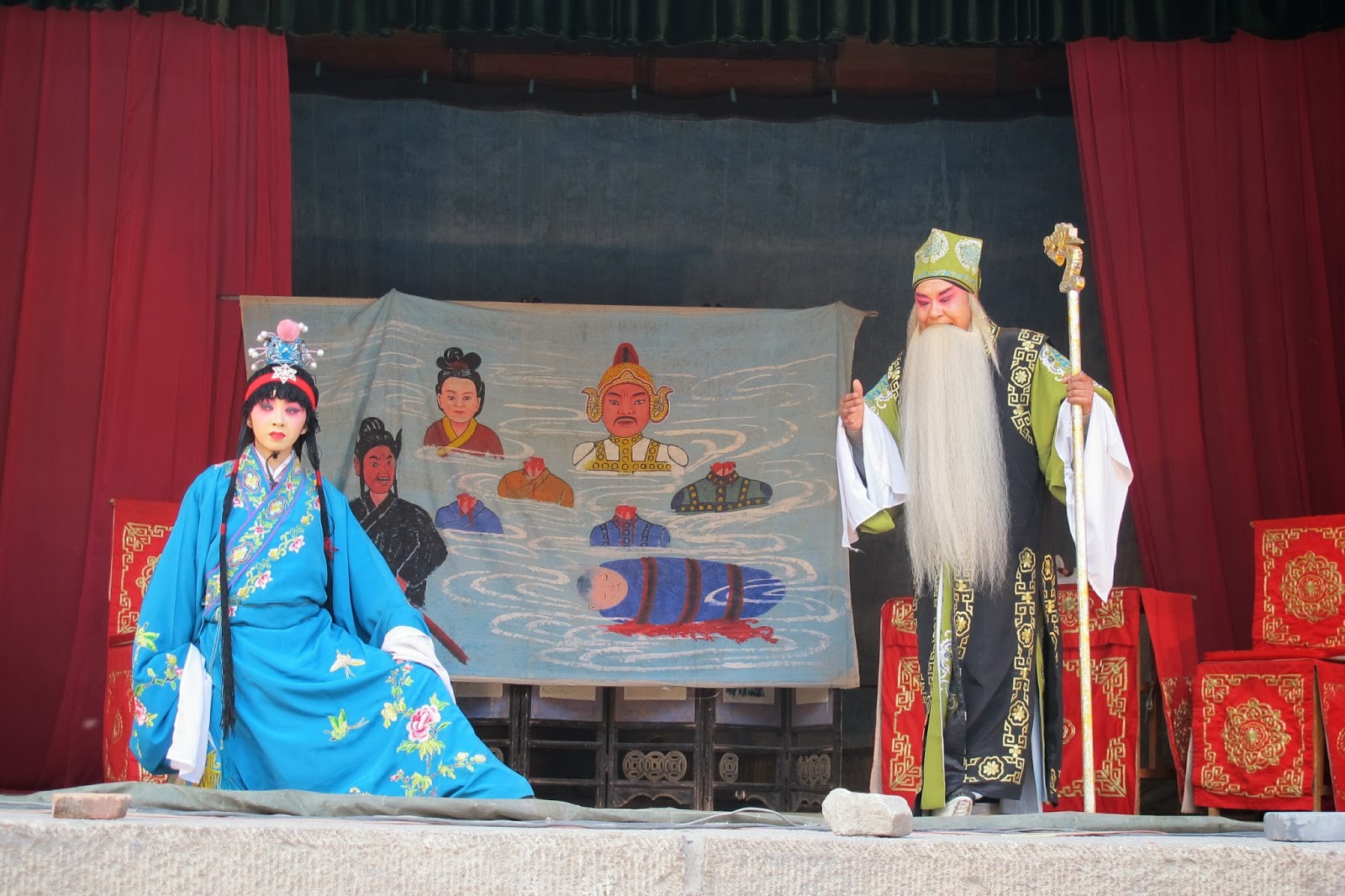
Waiting to on on stage

selling incense


begger lady

nun looking for a handout

We managed to annoy the best looking novice monk in
the whole Wutai Mountain. "Oh stop taking pictures already!" He exclaimed in
exasperation, then covered his face with a straw hat. Without doubt the
suffering he has to endure in this lifetime is the curse of beauty
!

The 5 most famous temples of Mt Wutai are : Xiantong
Temple, Tayuan Temple, Manjusri Temple ( Summit Bodhisattva ), Shuxiang Temple,
and Louhou Temple.
Xiantong Temple has the longest history and is the most
prestigious, therefore the Buddhist Association of Mt Wutai is placed here. The
copper bell in front of the gate is the biggest on the mountain and weighs
22,045.9 pounds. Its toll can be heard over the entire
mountain.

Tayuan Temple is a "must see", on account of the Big
White Pagoda (
大白塔), or Sarira Stupa named
after the Sanskrit word sarira meaning " Buddhist relic". Built in Nepalese
style, it is regarded as the symbol of Mt Wutai. It is about 75m high ,
constructed of brick with a lime coating that gives its white colour. Inside the
Pagoda is a small Indian-made iron stupa which holds some remains of Sakyamuni.


Happy worldly monks from Shenzhen


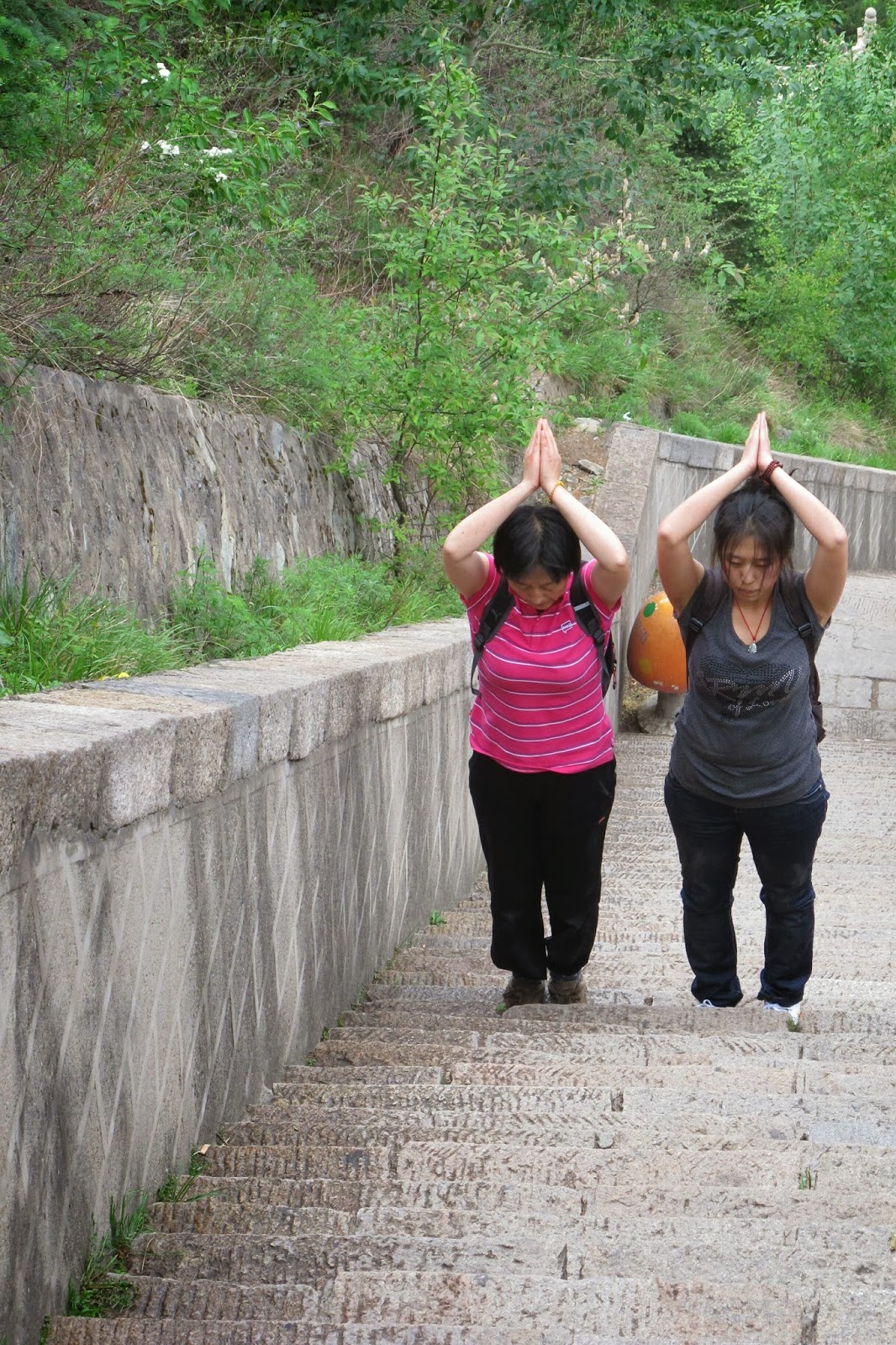
Manjusri Temple which houses the Bodhisattva statues resembling those from all 5 terraces, is at the Dailuo Peak ( dark Green Snail Peak), and can be reached either by climbing 1,080 steps, or by cable car. Climbing stairs' more interesting as I got to see the pilgrims at work.


shopping spree


I've been to a few grottoes but the Yungang Grottoes ( Cloud ridge Caves 云冈石窟) is definitely my favourite. The Yungang Grottoes' 1,500 year old and were China's first major stone carved grottoes . Carving work started in 460AD,and lasted approximately 60 years , resulting in 51,000 big and small carvings tucked away in 252 caverns in the entire complex. The Grottoes were cut directly into the soft sandstone cliffs of the Wuzhou Mountain and stretched for approximately a kilometre from east to west.

The Yungang
Grottoes were the relic of the Northern
Wei Dynasty (386-534), who were non-Chinese nomadic Tuoba Turks. They unified
northern China and established their capital at Pingcheng (modern-day Datong) in
the late 4th century. Their early rulers accepted the Buddhist religion of the
local population for religious, political as well as economic reasons. They recruited 3,000
monks from along the Silk Route to turn Buddhism into their state religion and
Buddhist monks even served as political advisors .

Caves 16-20 are thought
to be the earliest caves , each containing a huge figure at least 13 meters in
height ; all carved under the watchful eye of the head monk Tan Yao . Each
figure represents an Emperor from the Northern Wei Dynasty, albeit in Tathagata
Buddha forms, constructed at a time when the worship of the Buddha and the
Emperor were one and the same thing. The grottoes were to become a significant worship
center.

In 2001, UNESCO
recognised the Yungang Grottoes as one of
the most important historical sites in the world for their representations of
Buddhist art, sculpture and imagery. The Grottoes' special in that the carvings
are an assimilation of South and Central Asian arts. According to an early
history of the Wei, five Indian monks, accomplished sculptors, went to Pengcheng
in 455 to help with the construction . Therefore the earliest caves have
discernable western features, the carvings and the pillar architecture are
similar to the Indian chaityas, and some of the colossal Buddha statues follow
the northern Indian Gandhara style. Several of the statues of enormous size
(Caves 5, 16-19) appear even to have been influenced by the now destroyed
Bamiyan statues of Afghanistan. But one can also see Greco-Roman influence in
the stone porticos that front a number of the caves and in some of the
decorative motifs and minor figures. There are Iranian and Byzantine and other
influences, but the heavy decoration in caves 1, 2, 3, 5-13, the brightly
painted images of dragons and phoenixes and the Chinese-style roofs and brackets
as well as the nimbuses or aureoles of the Buddhist carvings, show the
distinctive Chinese character.


In 494, the
Wei moved their capital from Datong to Luoyang and the Yungang Grottoes slowly
fell into decay. The caves used to be protected by wooden temple buildings, but
most of them burnt down. Natural erosions, looters ( mostly in early 20th
century) and vandals, particularly during the Cultural Revolution, have all
taken their toll, as have some of the restorations that involved the
replastering of statuary and the sometimes unfortunate repainting of statues,
walls and other decoration.

Just 5 years
ago the Yungang Grottoes were surrounded by ugly
open-pit coal mines and sooty industrial plants. Now all that has been cleared
away, in place a huge car park was built, along with new gardens, fake lakes,
temples, shopping streets and a Visitors Center. Downsides are :1) visitors have
to walk 20 minutes (non-stop) to get to the caves, which are about a kilometers
from the car park ( for those who can't walk there're golfcarts ) ; 2)
the entrance fee has gone up from 40 yuan in 2008 to a whopping 150 yuan in
2011!

All these
were the doings of Datong's controversial Mayor, Geng Yanbo ( 耿彦波) . Geng came
into power in 2008 and immediately instituted a series of radical urban
re-development. But instead of creating a generic modern city with broad
boulevards, highways, office towers and luxury flats, Geng sought to creat a
glorious Chinese past by faux-historic buildings and restored ancient cities.
Datong, near the border with Inner Mongolia, has a
history of over 2,400 years. It was the capital of Northern Wei (386~534) for 96
years, as well as the capital of Liao (916~1125) and Jin (1115~1234). making it
a thriving political, economic and military center of ancient North China. It's
also a stop-off point for Camel Caravans moving from China into Mongolia and
beyond. Those prosperous days left the city a huge cultural heritage of that
time, most of them integrations of minorities and Han
culture.

A charismatic scholarly man, who also has an MBA diploma, Geng firmly believes the
future for Datong's population of 3.5 million people lies in its ancient past.
To this end Geng has acted resolutely: in order to turn one of the world's
dirtiest cities into a cultural showpiece, he demolished 140,000 houses
and relocated 500,000 people, earning him the nickname " Geng ChaiChai"( Geng
Smash Smash). The strategy was speculated to have 3-fold rewards : to
expand tourism and end the region's heavy reliance on coal ; to revive pride in
traditional China; and toe the line of the Government's massive
stimulus to prop up the economy in the aftermath of the collapse of export
trade.
Datong's construction boom came to a halt in February
2013 after Geng was suddenly demoted without any explanation. What subsequently
happened was bizarre even by China standard. When news of Geng's removal was
announced, thousands of residents took to the streets to petition for him to
stay, carrying placards that read :
" Please stay, Mayor Geng " and " Datong
needs you ". Some petitioners claimed they'd gathered as many as 10,000
signatures on one of their banners. Hundreds of residents knelt and chanted "
Mayor Geng, please come back, Datong is your home!" Datong News Center director
Gu Shengming said several officials wept during Geng's farewell party.
The cynics would have it
the residents were not so much petitioning for Geng as for their own pockets.
The real estate market as well as access to bank loans were unavoidably affected
by cessation of the projects, not to mention the billions of debt the city owns
which the residents're probably worried might fall on them to pay.

However, Geng did good to Datong in another important
area. Since China's open and reform period, Datong has become a
booming 'City of Coal' because of its large reserves of coal. Decades of rampant
mining choked the city in soot and grime, and made Datong one of China's most
polluted cities. During Geng's term
Datong's air pollution underwent significant improvement . According to data
from the Ministry of Environmental Protection, in 2005, the city's air quality
was ranked 115th out of 117 cities monitored, but by 2012, it was ranked 47 out
of 120 cities. Geng strived to transform Datong from a high-carbon to a low-
carbon city by developing solar energy industry. The target is to raise the
proportion of clean energy produced to 25 percent by the end of 2015. Datong is
classified as a rich area of solar resources by the wind and solar energy
resources assessment center of the China Meteorological Administration, as it's
located on the northeast side of the Loess Plateau at an altitude of 1,000 to
1,500 meters, and enjoys on average 2,800 hours of sunshine a
year.

It's
impossible to talk about Shanxi and not to mention coal. Over the past decades
Shanxi has seen massive growth on the back of coal, which has also created a
class of coal barons which frequently hit the news with their ostentatious
weddings and lavish lifestyles. On the other hand China has the world's worst
coal mine safety record for more than 2 decades . China produces 35% of the wrold's coal but contributes to 80% of coal fatalities. Since the Chinese media's free to report on the accidents in real time, a new term " blood coal" has been coined to reflect public outrage. Unregulated mining operations (
accounted for almost 80% of China's 16,000 mines) and gas explosions due to a
lack of required ventilation or fire control equipment are thought to blame.
However, the pay of 2000-3000 yuans a month is attractive enough to entice even
university graduates to go down the pit ( the GDP of Shanxi's still lapse far behind
that of coastal cities). On a happier note, a retired miner celebrated his
hundredth birthday the week I was in Shanxi, duly reported by the local
newspaper .

The true cost of coal goes so much deeper.
China is the largest consumer of coal in the world ; since 2008 China has
become a net importer of coal, Vietnam being the largest supplier, followed by
Australia. In rural areas domestic burning of coal is still permitted, usually
in unvented stoves. This has led to high indoor levels of toxic substances such
as arsenic, fluorine, polycyclic aromatic hydrocarbons, and mercury. The
resulted health issues include severe arsenic poisoning, skeletal fluorosis (
over 10 million afflicted in China), esophageal and lung cancers, selenium
poisoning, chronic obstructive pulmonary disease, and weakened immune system. In
Oct 2008, Greenpeace, World Wildlife Fund and The Energy Foundation published a
repoer that said the by-products of coal burning such as water pollution, air
pollution and human costs are costing China an additional 1.7 trillion yuan a
year, or more than 7% of GDP.
China has pledged to cut its carbon
intensity by about 40% by 2020, compared to 2005 levels. To this end, China has
invested 2.3 trillion yuan through 2015 in energy saving and carbon-reduction
projects. This is more than the US would ever do. Commentators have also pointed
out China has taken the lead in making the use of coal as energy source more
clean and responsible, e.g. China has built new ultra-supercritical coal plants
( 44% sfficiency) before the US, and requires companies building new plants to
retire an old plant for every new one built.
In Datong, besides the Yungang Grottoes, the other must-sees are the Nine Dragon Screen, the Hanging Monastery and the wooden Pagoda of Yingxian.
Nine Dragon Screen (九龙壁), beautifully hidden in a
high-walled courtyard, is one of the oldest, largest and best preserved glazed
screens in China. It was built over 600 years ago in honour of the 13th son of
Emperor Ming Taizu of Ming Dynasty ( 1368-1644). The design is that of green
waves below and blue and yellow clouds above nine flying dragons. In front of
the Screen is a pond with a stone bridge, so that the reflection of the dragons
in the water moves whenever a breeze ripples the surface of the water. Such
screens are typically found in Imperial Chinese palaces and gardens, because
according to Chinese superstition, ghosts and devils can only travel in straight
lines, so these screens were placed just so before residency gates in order to
block their way.

The Hanging Monastery
(懸空寺) is the major reason I decided to go to Shanxi in
the first place. Friends told me urgently there's a rumour that visitors would
be forbidden to walk inside the Monastery anytime now because the hordes of
tourists might have caused structural damage, so I was a trifle apprehensive.
What I didn't anticipate was that the real problem was
in getting there at all . Shanxi's new found prosperity resulted in a car
ownership boom which it's woefully unprepared for. On the way to the Monastery
we were stuck in a traffic jam that'd take hours to clear, so our guide made an
executive decision that we should get off the bus and walk the 2 kilometers to
the Monastery. I was about the only one who welcomed the arrangement, but I've
always found one sees a lot more on foot .

We had to walk through a canyon to reach the Monastery

Police Recruitment adv

The Hanging Monastery is a 1,500-year-old temple built in 491AD ( northern Wei dynasty) on the cliff of a hill at the foot of Mt Hengshan( 恒山) , one of the five most sacred mountains in China. It protrudes gingerly over the sides of the steep cliff over 50 meters above the Jinlong Canyon. Inside the Monastery there're 40 halls and alcoves ( half-room and half-cave), which contains about 80 sculptures made of copper, iron, bronze, terracotta, and stone.All the shrines are connected by narrow bridges, pathways and boardwalks. The Monastery is also special because it includes Buddhism, Taoism and Confucianism.

Entrance to the Monastery

Architectural experts
all over the world marvel at the ingenious construction. A unique mechanical
theory was applied in building the Monastery. Crossbeams shaped like arrows were
half-inserted into the rock cliff as the foundation, while the rock provided
support. Then the temple was built on the crossbeams. Seen from below, it looks
like a tumble-down castle in the air.
The biggest wonder of
all , however, was that it was built by only one man, a monk named Liao Ran
(了然 ). The reason it was built on the cliffside was to protect
it from floods, then the mountain peak
naturally protects it from rain and snow; and the mountain around it also
diminishes damage from sunshine. Another reason is the monks obeyed a principle
in Taoism : no noises, including those from rooster crowing and dog baying. From
the upper ground, all noises drop away. On the high cliff hemmed in by a
precipice on either side, the Monastery sits up there beyond reach in abject
solitude.

The
wooden Pagoda of Yingxian (佛宮寺釋迦塔) or better known by its generic
nickname of "Muta"( 木塔), literally meaning Timber Pagoda , was built
in 1056 during the Liao Dynasty, which ruled North China from 916 to 1125. It is
the oldest and largest wooden Buddhist pagoda in existence in the world, and is
regarded as one of the "Three Wonders of Pagoda in the world" together with
Eiffel Tower in France and the Leaning Tower of Pisa in Italy. The Wooden Pagoda
was made by wooden parts joined by innumerable mortises and tenons in a
complicated structure of brackets, without using any nails. Through the
centuries it has survived earthquakes, storms, lightenings and wars, no mean
feat !

Yingxian city


We had sometime to spare and the guide suggested that we visit the
Yanmenguan Pass ( 雁门关) or 'wild
goose pass' because wild geese are seen flying around the pass every
year. Yanmenguan Pass, situated on Yanmen Mountain, is one of three
outer passes of the Great Wall in the
Shanxi Provence. Located at a place of
strategic importance, it was regarded as the principal one of the Nine Passes under Heaven in ancient times. Many famous historical
battles have been fought here.


The first pass was built by the King Wuling of Zhao during the Warring States period, for defense against the Inner Asian nomads. In 1937 during the Japanese invasion this was the site of heated battles between the Eighth Route Army and the Japanese.


Yanmenguan and part
of the Great Wall undergone
repair and reconstruction in 2010 which was unfortunate, for I feel the new buildings have taken away much of the authenticity of the
area.

Local folks

Shanxi was one of the principle targets of the Japanese
Army in northern China during the Japanese War, a lot of the fighting took
place along the mountain ranges of Taihang Mt, Wutai Mt and Luliang Mt . China
was in a really bad place at the time, and was thus grateful for the help from
the legendary but controversial Dr Henry Norman Bethune ( 白求恩), who eventually died in
China. " Are there many museums and monuments to Bethune around here ?" I asked
Mr Wong. " So many!" The after-90s generation's obviously not interested in this
unusual doctor. For those of you who are interested, you might want to look
up my blog on Dr Henry Norman Bethune. Because Shanxi was the
frontline battlefield, there're miles of underground tunnels dug in many parts
of the province. We were taken to one of them and crawled through a tiny part of
the renovated section.


One of the entrances to the underground tunnels


"Do a lot of young people want to leave Shanxi and make
a living elsewhere?" I asked Mr Wong. "Some do," he said" but like me a
lot actually want to stay, Shanxi people's very attached to home" he explained,
and I felt a twinge of envy. My family's Guangtong Hakka ( 廣東客家, guests
who made home here) and we never knew our origin. My cousin Emily prefers to believe we originated from Shanghai, because the Shanghai girls're
the most chic in China, but that's just wishful thinking. I do remember
overheard someone said we could be from Shanxi when I was a child, since
then I've cultivated a warm feeling for Shanxi. Or maybe it's because I've
been listening to Shanxi folk songs for as long as I can remember, songs like "
Why are the flowers so red?"( 花儿为什么这样红), "The little river flows"(小河淌水),
"Embroidered Bag"(绣荷包), "Jasmine" (茉莉花), "Moving Westward"(走西口)........ my all
time favourite, however, is "People say Shanxi has good scenery"(人说山西好风光).
Whatever the reason, certainly I've never felt so instantly at home in Shanxi
than anywhere else I've travelled in
China.

Paper-cut is another Shanxi folk art. On festive
occasions, it is used as decoration on the door, window and ceiling of the cave
dwelling (yaodong 窰洞), kang ( 炕) , furniture
or even clothing. Before we left Shanxi we were each given a paper cut as a
memento, made up of the Chinese character 福 , which I've put into my painting. The painting also features the Hukou Tea Kettle Spout Waterfall. 福 is a hard word to translate adequately, it means a great deal more than ' good fortune' which is the standard English translation, but it expresses very well my wish for Shanxi, the most " Chinese" province in China.


